


Is it legal to sell IPTV boxes in the US? Mostly yes, as long as you’re selling the hardware and nothing else. A stock Android TV box or Firestick is ordinary retail. The trouble starts when you preload unlicensed IPTV apps, sell subscriptions or reseller credits, or advertise free channels. That’s when copyright law, Section 605 of the Communications Act and the Protecting Lawful Streaming Act come into play. Here’s how US rights holders separate a normal gadget sale from a lawsuit.
If you’re asking is it legal to sell IPTV boxes in 2026, you probably run a small device business. Or you’re about to start one. This guide takes the seller’s side of the counter. It shows where the law separates hardware, software, setup services and access, and which marketing words turn an ordinary gadget sale into something a plaintiff’s lawyer will happily print out and staple to a complaint.
This isn’t legal advice. It’s a plain-English look at the ‘is it legal to sell IPTV boxes’ question through how US rights holders actually build cases against sellers. Use it to answer is it legal to sell IPTV boxes for your own business before someone else decides that for you.
Why IPTV Box Sellers Get Sued Before Their Customers Do
A recent DISH Network lawsuit against a New York-based box seller made the rounds in cord-cutting forums. For anyone wondering is it legal to sell IPTV boxes, the specifics matter less than the pattern. Pay-TV companies and studio coalitions go after the people selling access, not the people watching, and they’ve done it this way for years.
Sellers Leave a Paper Trail
A viewer on the couch is close to anonymous. A seller isn’t. Think about what a typical small operation has: a storefront on Amazon, eBay, Etsy or Facebook Marketplace, a PayPal or Stripe account, maybe an LLC registered with the state, a phone number, and quite often a website with a street address sitting right there in the footer.
Every one of those is a discovery target, which makes ‘is it legal to sell IPTV boxes’ a far more personal question for sellers than for viewers. Lawyers can subpoena payment processors. Marketplace accounts tie back to real names and bank details. And that Facebook post bragging about “500+ channels”? Someone screenshots it, and it becomes Exhibit C.
Why Pay-TV Providers and ACE Target the Middle of the Chain
The Alliance for Creativity and Entertainment (ACE) formed in 2017. Its members include Amazon, Netflix and the major Hollywood studios, and it focuses heavily on distributors. DISH does too, through one of the most aggressive anti-piracy litigation programs in the country. The logic is simple. Sellers profit directly, advertise in public and are easy to find, so they’re the most efficient target available.
One lawsuit against one seller can cut off hundreds or thousands of customers in a single move. Suing individual viewers? Slow, expensive, and a PR disaster. That’s why US lawsuits against home users are rare, which we cover in more depth in What IPTV Legal Risks Actually Mean for Subscribers.
Two well-known examples: ACE’s suits against TickBox TV and Dragon Box. Both companies sold hardware marketed around free streaming. Neither ran the underlying streams. Both still landed in federal court.
Is It Legal to Sell IPTV Boxes? Hardware vs Software vs Access
The honest answer to “is it legal to sell IPTV boxes” is frustratingly lawyerly: it depends on what’s in the box and what you say about it. To answer is it legal to sell IPTV boxes properly, break it into separate activities, each with its own risk level. Plenty of sellers do two or three of these at once without realizing they’ve stacked their exposure on top of each other.
| Activity | Typical US risk level | Why |
|---|---|---|
| Selling stock, unmodified devices | Low | Ordinary retail of general-purpose hardware |
| Setup on a customer’s device with licensed apps only | Low | A tech service, like installing a router |
| Selling devices preloaded with unverified IPTV apps or addons | High | Bundling plus marketing can show inducement |
| Setup that installs unlicensed IPTV for a fee | High | You’re configuring access as a paid service |
| Selling IPTV subscriptions, credits or reseller panels | Highest | You’re directly selling access to the service |
Selling a Stock Android TV Box or Firestick
A factory-sealed Fire TV Stick (usually somewhere around $30–$60 depending on the model and sale), a Walmart Onn box, an Nvidia Shield or a generic Android TV box is no different, legally, from a laptop. These are general-purpose devices with tons of legitimate uses. Courts have long held that hardware capable of substantial lawful use isn’t illegal just because some buyers misuse it.
Reflashing firmware or swapping in a custom launcher isn’t automatically a problem either. The legal question is what content access you provide and promote. When people ask is it legal to sell IPTV boxes, the device itself is rarely the issue.
Selling Devices Preloaded With Unverified IPTV Apps or Addons
Here’s where the answer to is it legal to sell IPTV boxes flips, and where most box sellers get burned. Load up a device with unverified IPTV apps or Kodi addons that pull unlicensed live channels, sell it as a package, and you’ve changed the product. It’s no longer hardware. It’s a ready-made way to watch content you have no rights to.
A quick word on “jailbroken Firestick.” Sideloading apps onto a Fire TV device doesn’t break any copy protection, so the term is marketing slang, not a technical description. Which means asking whether selling jailbroken Firesticks is legal kind of misses the point. Nobody’s suing over the “jailbreak.” They’re suing over the preloaded access and how you advertised it.
Bundling plus marketing. That’s the combination that changes the answer to is it legal to sell IPTV boxes and turns a gadget sale into inducement. A box with Kodi alone is a media player; a box with Kodi, five live TV addons and a listing promising “every channel free” is a case file waiting to be opened.
Selling IPTV Subscriptions, Credits or Reseller Panels
Reseller panels and credit systems get their own tier, and at this level ‘is it legal to sell IPTV boxes’ stops being the right question entirely. Buy credits from an upstream provider, sell monthly logins to customers, and you are directly selling access. You’re inside the distribution chain, not a hardware shop that happened to preinstall something.
A lot of resellers assume the “real” provider carries the legal risk. My read is that this gets it backwards. The anonymous operator behind the panel might be offshore and hard to locate, while the reseller often has a US bank account, a local Facebook page and a name. If the chain itself is fuzzy to you, start with IPTV Resellers vs Real Providers: Who Runs Your Service?.
Charging for Setup on a Customer’s Own Device
Is a Firestick setup service legal? Generally, yes, as long as you’re installing licensed apps like Sling, YouTube TV, Pluto TV, Tubi or a VPN. You’re selling labor and know-how. Same as a Geek Squad visit.
It changes fast if your “setup” means installing unlicensed IPTV apps and typing in a subscription you sold them. Labeling it a service fee doesn’t change what you actually delivered.
Is It Legal to Sell IPTV Boxes Under US Law? The Statutes Used Against Sellers
Rights holders almost never rely on one statute. Complaints stack claims, and each claim brings its own damages math. Here’s what each law covers, without the legalese.
Copyright Infringement and Inducement Liability
Under the US Copyright Act, statutory damages run from $750 to $30,000 per infringed work, and up to $150,000 per work if a court finds the infringement willful. The damages provision is in Chapter 5 of Title 17 on the US Copyright Office site. Now multiply by dozens or hundreds of shows, films and channels. The totals get ugly quickly.
Box sellers usually aren’t accused of hosting anything. Plaintiffs instead lean on secondary liability, especially the inducement theory from the Supreme Court’s 2005 MGM Studios v. Grokster decision. Grokster held that if you distribute a product with the object of promoting infringement, shown by clear expression or other affirmative steps, you’re liable for the infringement that follows.
So your marketing matters. A lot. Under Grokster, ad copy is often the clearest evidence of intent a plaintiff has.
Read next: What IPTV Legal Risks Actually Mean for Subscribers
Federal Communications Act Section 605
47 U.S.C. § 605 prohibits unauthorized interception, receipt, publication or retransmission of certain communications. Congress originally aimed it at satellite and cable signal theft. DISH pleads it routinely in IPTV cases anyway, arguing that its satellite programming gets captured and retransmitted online. Statutory damages typically go up to $10,000 per violation, with enhancements of up to $100,000 per violation when the conduct was willful and for commercial gain.
There’s also a separate provision targeting people who sell or distribute devices intended for unauthorized decryption, and that one can carry per-device damages. Does Section 605 really fit internet streaming? Defendants still argue it doesn’t in some cases. Don’t bank on that argument saving you, though, particularly in a default judgment where nobody shows up to make it.
DMCA Anti-Circumvention and Trafficking Rules
Section 1201 of the Digital Millennium Copyright Act bans circumventing technological protection measures. It separately bans trafficking in tools built to do that. Civil damages under Section 1203 can run from $200 to $2,500 per act of circumvention or per device sold, and willful commercial violations can be prosecuted criminally.
Most preloaded boxes don’t involve circumvention at all, since sideloading an APK doesn’t defeat DRM. The DMCA comes into play when a seller ships tools that strip encryption from paid services or capture protected streams. Less common in box cases. Still shows up in complaints.
Protecting Lawful Streaming Act of 2020
The Protecting Lawful Streaming Act (PLSA) was signed in December 2020, tucked inside a much larger spending bill, and is codified at 18 U.S.C. § 2319C. Before it existed, illegal streaming generally counted as a misdemeanor public-performance offense, while illegal downloading could be a felony. Odd gap. The PLSA closed it.
It makes it a felony to willfully offer or provide, for commercial advantage or private financial gain, a digital transmission service that is primarily designed for unauthorized streaming, has no commercially significant purpose beyond that, or is intentionally marketed for it. Penalties reach up to 3 years in prison, with longer terms for aggravated and repeat offenses.
The bill’s sponsors said plainly that it targets operators and commercial services, not individual viewers. For resellers, the open question is how far “offering or providing” a service stretches down the chain. Courts haven’t drawn that line clearly yet, as far as I can tell. A small reseller selling logins for profit sits closer to it than a shop selling sealed Firesticks, and prosecutors have real discretion here.
Marketing Phrases That Create Legal Exposure
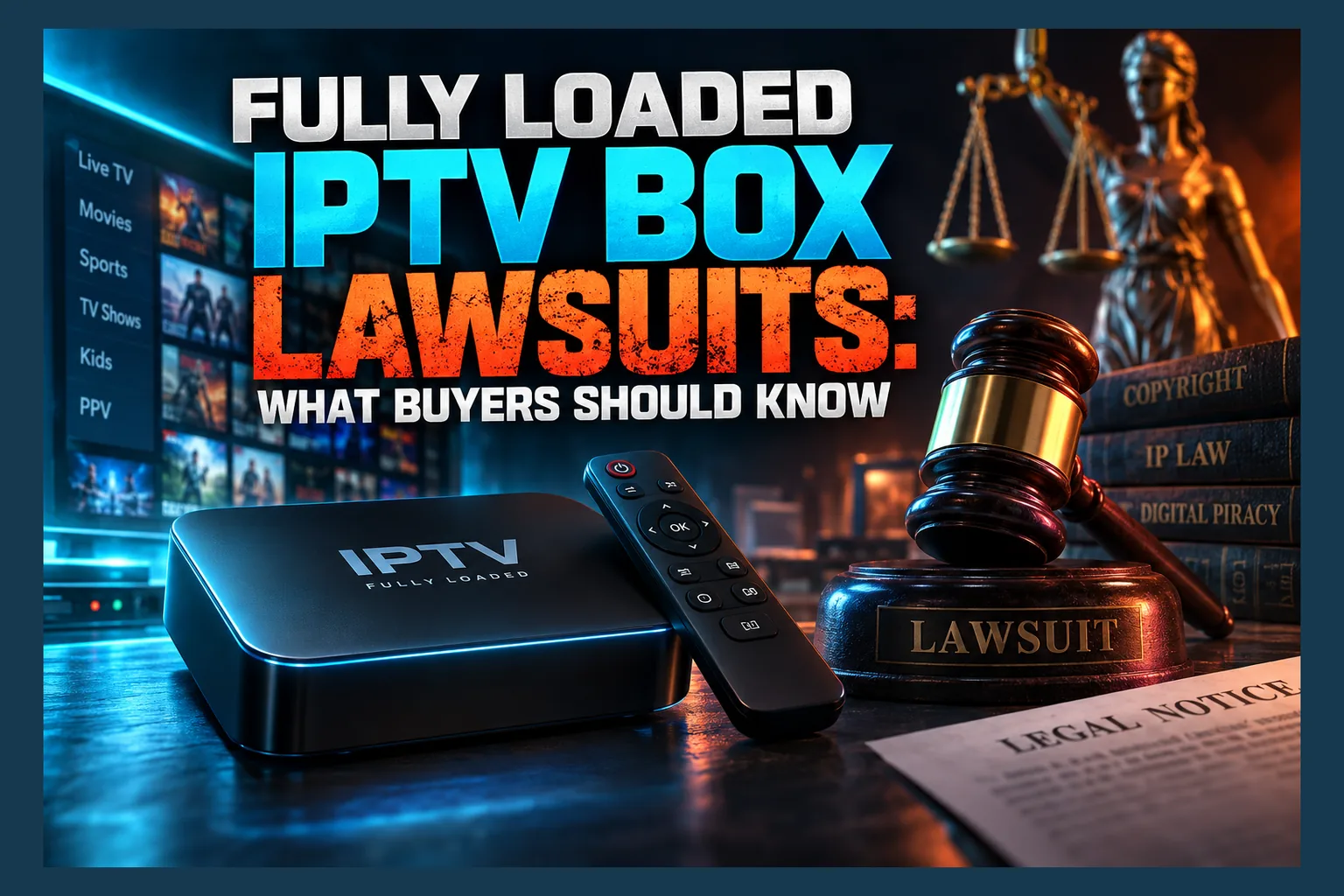
In nearly every preloaded streaming box lawsuit, the complaint quotes the seller’s own listings right back at them. That’s how plaintiffs prove intent. It’s also how “I just sell boxes” becomes inducement. If you only remember one section of this guide, make it this one.
‘Fully Loaded’, ‘Free Cable Forever’ and ‘No Monthly Bills’
“Fully loaded.” “Free cable forever.” “Cancel cable today.” “No monthly bills.” Every one of those says the same thing: this device replaces paid TV without paying for it. That’s exactly the kind of clear expression the Grokster standard looks for. Some sellers figure fuzzy wording protects them (it mostly doesn’t), because courts look at the overall message rather than parsing individual words.
Channel Lists, Logos and PPV Promises in Listings
A list of premium channels, network logos in your product photos, or a promise of “all PPV events included” ties your product directly to specific copyrighted content. The logos also invite trademark claims on top of everything else. And screenshots of a channel guide full of premium networks are among the most common exhibits in these cases.
| Lower-risk wording | High-risk wording |
|---|---|
| “4K Android TV box, 4GB RAM, Wi-Fi 6” | “Fully loaded box, 10,000+ channels” |
| “Setup for YouTube TV, Sling and Pluto TV” | “Free cable forever, no monthly fees” |
| “Plex and Jellyfin configured for your media library” | “Every sports package and PPV included” |
| “Bring your own licensed subscriptions” | “Cancel cable, keep all your channels” |
| Generic product photos of the device | Photos showing premium network logos and channel guides |
One caveat. Wording alone won’t make an illegal setup legal. If the box still ships with unlicensed IPTV, a cleaned-up listing just removes one exhibit, not the underlying problem.
What Usually Happens to Sellers: The Enforcement Ladder
Most sellers don’t jump straight from a listing to a federal courtroom. Enforcement tends to climb a ladder, and every rung is a signal to stop. The cases that make headlines usually involve sellers who blew past several earlier warnings.
Marketplace Takedowns and Payment Processor Bans
Rung one: a removed listing. Amazon, eBay and Facebook Marketplace all prohibit devices preloaded with unauthorized streaming access, and rights holders file reports in bulk. Keep relisting and you’re looking at account suspension, held funds and eventually a permanent ban.
PayPal and Stripe also shut down accounts tied to unlicensed streaming, sometimes freezing balances for months. For a small seller, losing payment processing can kill the business faster than any lawsuit would.
Cease-and-Desist Letters and ACE Notices
Then come the cease-and-desist letters, often from ACE or a pay-TV company’s outside counsel. They typically demand that you stop selling and name your suppliers, and some ask you to sign an agreement or pay a settlement. Sellers who comply quickly sometimes avoid a lawsuit entirely.
Don’t ignore these letters. And if the demands are significant, don’t answer them on your own (yes, even if the letter feels like a bluff). A short consultation with an IP attorney costs less than almost any outcome that follows silence.
Civil Lawsuits and Default Judgments
When letters fail, a federal civil suit follows. Many defendants never respond at all, and the court enters a default judgment. With nobody contesting the damages, judges often award amounts based largely on the plaintiff’s own calculation.
That’s how some judgments hit millions of dollars against tiny operations. Those numbers tell you less about typical outcomes and more about what happens when a defendant simply doesn’t show up.
Criminal Referrals
Criminal prosecution sits at the top. It’s also the rarest rung, mostly reserved for operators of large services or high-volume commercial distributors, and the PLSA now gives prosecutors a felony option. Our coverage of IPTV crackdowns and what they mean for subscribers shows how these cases usually focus on the top of the chain.
Lower-Risk Ways to Run a Streaming Device Business
The demand for streaming device help is real. Older customers, first-time cord-cutters, people who just bought a TV and can’t find the input button. You can build a business around that without taking on IPTV reseller legal risks. Here’s what it looks like.
Selling Unmodified Devices With Official Apps
Sell devices as they come from the manufacturer, or with official app-store apps only. Free ad-supported services like Pluto TV, Tubi, The Roku Channel and Samsung TV Plus offer hundreds of live channels legally, though exact lineups shift over time. That’s a genuine selling point. You can advertise it honestly, no asterisks.
Offering Setup for Licensed Services Only
Charge for time and expertise: account setup, remote pairing, Wi-Fi troubleshooting, walking someone through the apps until they’re comfortable. Setting up a VPN for privacy on public Wi-Fi or while traveling is another legitimate add-on. So is installing Plex or Jellyfin for a customer’s own media library, which has clear legal footing.
Keep a simple record of what you install on every device. A checklist the customer signs works, and so does an emailed receipt listing each app. If questions ever come up, documentation showing you installed only licensed software is strong protection, and it takes maybe two minutes per job.
Recommending Legal IPTV and Live TV Options
Customers who want sports and network channels should go to licensed live TV services. YouTube TV, Sling TV, Hulu + Live TV and Fubo cover most of what people ask for, with monthly prices that, as of late 2025, range roughly from the $40s up past $80 depending on the plan. Some customers will happily pay you to set one up. Our YouTube TV guide is a handy reference to share when they’re comparing options.
Availability varies by region. Serving customers in Canada or the UK? Several of those services aren’t offered there, so point people toward local licensed options instead.
If You Bought a Box From a Seller Who Got Sued
Buyers are in a different spot than sellers, and we’ve covered that separately. Start with IPTV Legal Risk in 2026: What Subscribers Actually Face for a realistic look at what’s likely to happen.
On the practical side, factory reset the device and remove any apps you don’t recognize. Change any passwords you typed into it. Then reinstall only apps from the official app store.
Conclusion: Is It Legal to Sell IPTV Boxes in the US?
So, is it legal to sell IPTV boxes? Selling stock hardware is legal. Charging for setup with licensed apps is legal too. The exposure comes from preloading unlicensed IPTV, selling subscriptions or reseller credits, and marketing that promises free premium content.
Want a business that survives 2026 and beyond? Sell the device and your expertise, not the access. And if you’re already deep into reselling, my blunt advice is to talk to an IP attorney now, before a rights holder sets the timeline for you.
This article is general information, not legal advice. Laws and their interpretation change, and outcomes depend on specific facts. Consult a licensed attorney in your jurisdiction about your situation.
⚖️ Legal Disclaimer: IPTV Wire does not own or operate any streaming service, application, or website mentioned in this article. We do not verify whether third-party services carry proper licensing. Users are responsible for ensuring they comply with copyright laws in their jurisdiction.
Frequently Asked Questions
Is it legal to sell Android TV boxes with Kodi installed?
Kodi itself is legal, open-source media software. A box with plain Kodi is generally low risk. The liability comes from preloading addons that stream unlicensed content, especially when the listing says something like “free TV.”
Can I get in trouble for reselling IPTV subscriptions or credits?
Yes. Reselling credits or logins for an unlicensed service means you’re directly selling access, the highest-risk activity in this space. Resellers can face civil claims, and commercial distribution may fall under the PLSA.
Is it legal to charge people to set up their Firestick?
Generally, yes, if you install licensed apps like YouTube TV, Sling, Pluto TV or a VPN. It gets risky once the setup includes unlicensed IPTV apps or a subscription you sold the customer.
What law does DISH use to sue IPTV box sellers?
DISH commonly relies on Section 605 of the Federal Communications Act, which covers unauthorized interception and retransmission of programming. Its complaints often tack on copyright infringement claims too.
Does the Protecting Lawful Streaming Act apply to small resellers?
The PLSA covers anyone who willfully offers an illegal streaming service for commercial gain, and it sets no size threshold. Prosecutors mainly use it against operators, but a profit-driven reseller sits closer to its scope than a viewer or a hardware retailer does.
Can Amazon or eBay ban me for selling preloaded streaming boxes?
Yes. Both marketplaces prohibit devices preloaded with unauthorized streaming access. They can pull your listings, and repeat violations can lead to account suspension and held funds.
Comments
Leave a comment
Your email address will not be published. Comments are moderated before they appear.