

Table of contents
Kodi VPN split tunneling is the step most guides skip, and it’s the one that makes a VPN livable on a streaming box. I’ve spent months testing on my own Firesticks and Google TV boxes, and the pattern holds. Route Kodi through the tunnel, keep Netflix, Plex and your debrid traffic where they belong, and most slowdowns and proxy errors go away. This guide skips the install and covers what to configure once your VPN is already running, current as of early 2026.
Still shopping for a VPN? Pick and install one first, then come back. Everything below assumes you already have a working VPN app on your device and you want it to cooperate with Kodi, your official streaming apps and your debrid account, instead of fighting all three.
Why ‘Just Turn On the VPN’ Isn’t the Whole Kodi Setup
Nearly every provider ships with the VPN covering your whole device and Kodi VPN split tunneling switched off. It’s simple. It’s also why a lot of people give up on their VPN within the first week, usually right after Netflix throws its third proxy error of the evening.
What a Full-Tunnel VPN Does to Every App on Your Device
A full-tunnel VPN sends every byte from every app through an encrypted server, and that server often sits hundreds of miles from your house. Kodi goes through it. So do Netflix, YouTube, your Plex client, the Amazon Appstore and even background firmware updates.
Every one of those detours adds latency. Every one eats bandwidth. The encryption overhead isn’t free on a $40–$60 streaming stick either, because the Firestick’s modest ARM chip has to encrypt and decrypt all of it. Weaker devices feel that, especially with two streams running at once, which is one more reason Kodi VPN split tunneling pays off.
Where Kodi Users Notice Problems First
From what I’ve seen, the complaints show up in a fairly predictable order:
- Official apps break first. Netflix shows a proxy error, Peacock refuses to play, or BBC iPlayer decides you’re suddenly not in the UK.
- Local network features vanish. The Plex or Jellyfin server sitting on the same Wi-Fi just disappears.
- Debrid authorization gets flaky. Real-Debrid links resolve on Monday and fail on Tuesday.
- Everything feels sluggish. Streams take longer to start, even in apps that never needed a VPN.
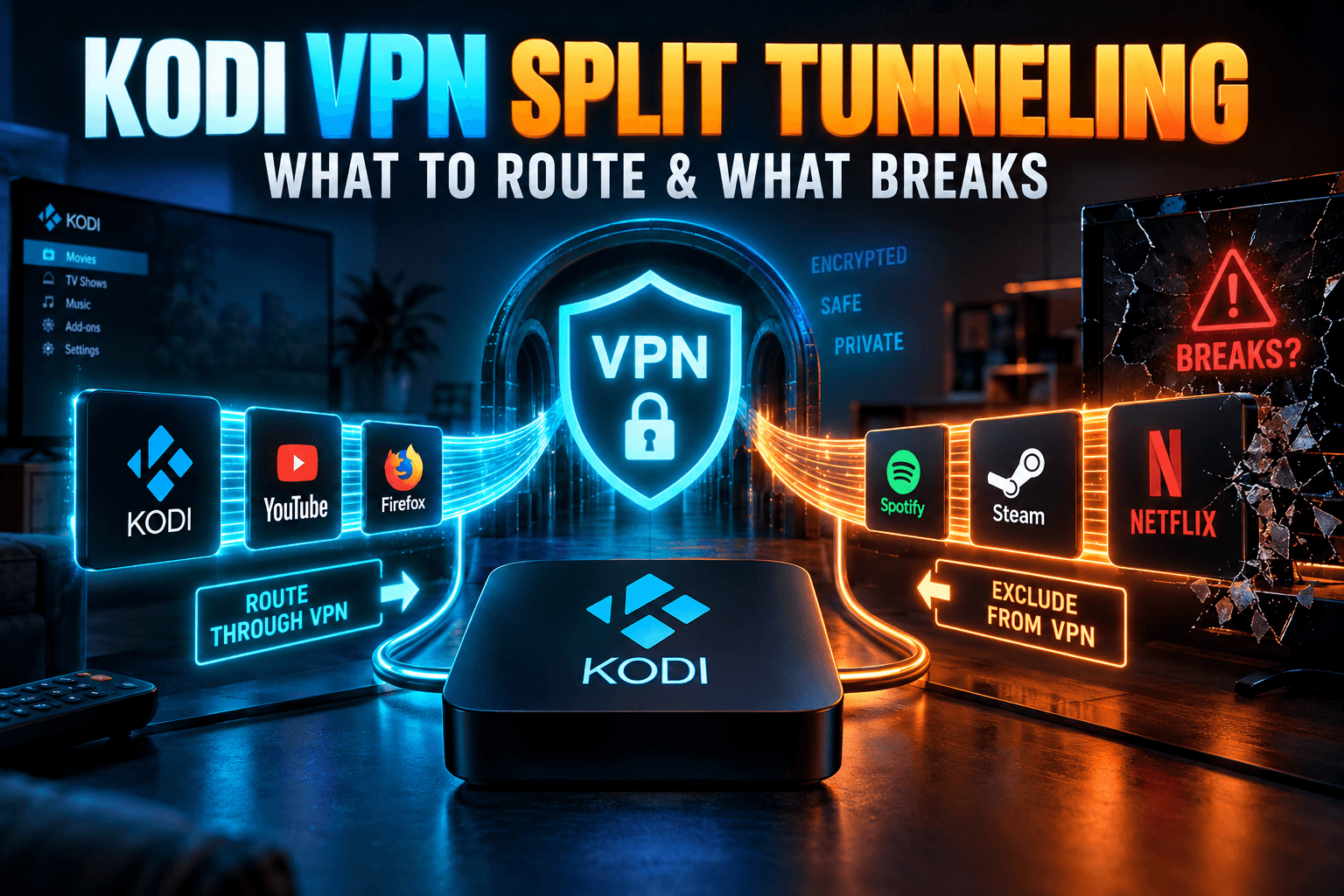
Kodi VPN split tunneling fixes this. You choose which apps use the VPN and which go straight out through your ISP. It’s the configuration step that comes after installation, and most tutorials skip it entirely.
How Kodi VPN Split Tunneling Works on Firestick, Android TV and Google TV
Think of Kodi VPN split tunneling as two lanes. One is encrypted and runs through the VPN. The other is your normal home connection. You decide which traffic takes which lane. If you want the networking theory behind it, Wikipedia’s split tunneling entry covers it well.
App-Based vs. IP/Domain-Based Split Tunneling
VPN apps handle the split in one of two ways:
- App-based: You pick apps from a list, either “only these apps use the VPN” (inclusive) or “everything except these apps uses the VPN” (exclusive). This is what you’ll see on Fire OS and Android TV.
- IP/domain-based: You route by destination, for example by sending all traffic for a particular domain outside the tunnel. You’ll mostly find this on desktop clients and routers.
For Kodi VPN split tunneling on a streaming box, you’ll be using the app-based kind. I strongly prefer inclusive mode when the VPN offers it. Put Kodi and your other third-party players in the tunnel and leave everything else alone. An exclusion list grows every time you install something new, and you’ll forget to update it. Ask me how I know.
Which Platforms Support It (and Where It’s Missing)
| Platform | Split Tunneling Support | Notes |
|---|---|---|
| Fire TV / Firestick (Fire OS) | Yes, app-based, in most major VPN apps | Feature names vary: “Split Tunneling,” “Bypasser,” “Allowed Apps” |
| Android TV / Google TV | Yes, app-based | Generally the most complete implementations |
| Apple TV (tvOS) | Mostly no | tvOS VPN apps exist, but per-app routing is rare to absent |
| Windows / macOS Kodi | Varies by provider | Windows clients usually support it; macOS support is patchier |
| LibreELEC / CoreELEC | Not natively | Requires manual routing rules or a router-level setup |
Apple TV owners mostly miss out on Kodi VPN split tunneling and are stuck with full tunnel. I haven’t found a tvOS VPN app with dependable per-app routing yet, though I haven’t tested every provider’s latest build. Your realistic options are toggling the VPN on and off by hand or moving it to your router. One more wrinkle: Amazon’s newer Vega OS devices, starting with the Fire TV Stick 4K Select in late 2025, don’t run Android apps at all. They don’t run Kodi either, so this whole guide applies to Fire OS models only.
Why Router VPNs Handle This Differently
A router VPN works at the network level. It routes by device or IP address, not by app. You could send your whole Firestick through the VPN and keep your smart TV outside it. That’s handy, but unlike Kodi VPN split tunneling on the device itself, it can’t separate Kodi from Netflix on the same box. I went deep on that approach in VPN on Your Router: What Actually Changes for IPTV, so this article sticks to device-level Kodi VPN split tunneling.
Kodi VPN Split Tunneling: What Should Go Through the VPN (and What Shouldn’t)
People get this part of Kodi VPN split tunneling wrong more than any other. Below is the routing table I run across my own devices. It’s the product of a lot of reinstalls and more trial and error than I’d like to admit.
| App / Traffic | Route | Why |
|---|---|---|
| Kodi (and forks) | VPN | Addon scrapers and third-party sources are the main privacy concern |
| Stremio | VPN | Same reasoning as Kodi, especially with torrent-based addons |
| Third-party IPTV players (TiviMate, IPTV Smarters, etc.) | VPN | Hides activity from your ISP and helps with ISP throttling |
| Netflix, Disney+, Prime Video, Max, Peacock | Direct | Avoids proxy errors and keeps your home region’s catalog |
| BBC iPlayer, ITVX, CBC Gem, Crave | Direct (if you’re in-region) | Geo checks often flag VPN IPs, even same-country servers |
| Plex / Jellyfin / Emby clients (local server) | Direct | Needs LAN access to find your server |
| Downloader, Appstore, system updates | Direct | Faster downloads, nothing to hide |
| YouTube | Direct | No benefit to tunneling, and VPN IPs trigger more captchas |
| Debrid-connected addons | Depends (see below) | Must match how you authorized your debrid account |
Route Through the VPN: Kodi, Stremio, Third-Party IPTV Players
These apps connect to sources you don’t control. A single search in a Kodi addon can hit dozens of sites, and without a VPN your ISP sees every one of those connections. That’s the traffic worth protecting.
Third-party IPTV players also benefit if your ISP throttles video. On a couple of US cable providers, I’ve watched evening slowdowns vanish once IPTV traffic went through the tunnel. Your mileage will vary by ISP and region, and some providers don’t throttle at all.
Keep Outside the VPN: Official Streaming Apps, Local Media Servers, Downloader
Official apps gain nothing from a VPN if you’re watching your home catalog. Worse, they actively block known VPN IP ranges. Excluding them saves bandwidth and gets rid of those “you seem to be using an unblocker or proxy” screens.
Local media servers are the bigger headache. Your Plex or Jellyfin client reaches the server over your LAN. Push that client through the tunnel and it can lose sight of the server entirely, unless your VPN has an “allow LAN traffic” toggle. Plenty of Fire OS VPN apps don’t have one.
Downloader is minor. I still exclude it. Sideloading a 60MB APK through a server three states away is slower for zero benefit.
The Gray Zone: Debrid-Connected Addons
Now it gets messy. Your Kodi addons talk to Real-Debrid, and so does the phone or laptop browser you use to authorize the account. If those two take different routes, you’ve created the IP mismatch problem covered in the next section.
Real-Debrid, Premiumize and VPNs: The Conflict Nobody Explains
There’s a reason “Real-Debrid VPN blocked” is such a common search. Debrid services and VPNs have a complicated relationship, and split tunneling can make it much better or much worse.
Why Debrid Services Flag Changing IPs
Real-Debrid’s terms limit an account to one IP at a time. The rule is there to stop account sharing. Their systems watch for several IPs hitting the same account at once, and when they spot it, they may restrict or suspend the account.
A VPN changes your IP. Split tunneling can mean you’re running on two IPs simultaneously: your real one in a browser and the VPN one in Kodi. From Real-Debrid’s side, that can look exactly like sharing.
Premiumize has historically been more relaxed about VPNs, and I’ve personally hit fewer snags with it. AllDebrid falls somewhere in between. Policies change, though. Read each service’s current terms instead of trusting a Reddit thread from 2022.
Shared vs. Dedicated IP Considerations
Most VPN servers are shared, with hundreds or even thousands of people exiting from the same address. Debrid services sometimes block entire datacenter IP ranges for abuse. Your chosen server might be flagged before you ever connect.
A dedicated IP add-on, usually somewhere around $3–$8/month on top of your plan depending on the provider, gives you an address nobody else touches. For heavy Real-Debrid users, I think it pays for itself in avoided headaches. It also breaks the “new IP every reconnect” pattern that tends to trip fraud checks.
Keeping Authorization and Streaming on the Same Route
Consistency is the whole fix. Whatever route Kodi takes, your debrid traffic should take too. This is the order I follow:
- Connect the VPN and confirm Kodi is in the tunnel.
- Pin a specific server. Don’t use “fastest server” auto-selection.
- Start the debrid authorization from inside Kodi (Seren, Umbrella and most addons show a code).
- Enter the code at real-debrid.com/device on a device that’s also on the VPN, or do it quickly and close the browser right after.
- Avoid streaming from Kodi on two devices with different routes at the same time.
On Seren or Umbrella, a failed authorization often appears as “no sources found” instead of a clear error. The scrapers run fine. The cached links just never resolve. I break down how Umbrella’s fork handles debrid differently in Infinity vs Umbrella Kodi Addon: What the Fork Changes.
Kill Switch + Split Tunneling: Settings That Fight Each Other
A kill switch is supposed to cut your internet when the VPN drops. Pair it with split tunneling and things get less predictable than most people expect.
How Kill Switches Behave When Apps Are Excluded
In most Android and Fire OS VPN apps, the kill switch only covers apps inside the tunnel. Excluded apps keep working if the VPN drops. That’s usually what you want, since there’s no reason Netflix should stall because your VPN reconnected.
Inclusive mode is the catch. If you set “only Kodi uses the VPN,” check whether the kill switch actually blocks Kodi when the tunnel goes down. Some apps get this right. Others simply stop routing Kodi through the VPN and let it fall back to your real connection. Silently.
Always-On VPN in Android Settings
Android TV and Google TV offer two system-level options under Network settings: Always-on VPN and Block connections without VPN. The exact path varies by manufacturer (it’s buried three menus deep on some boxes, annoyingly). Fire OS doesn’t expose either option in its menus.
Enabling “Block connections without VPN” can override your split tunnel. On several Android versions, it blocks excluded apps outright, because technically they have no VPN connection. I ran into this on my Onn box. Netflix just spun forever until I turned off the system-level block and let the VPN app’s own kill switch do the job.
My advice? Turn on Always-on VPN so the tunnel comes back after a reboot, but leave “Block connections without VPN” off if you’re splitting traffic.
Testing for Leaks After Configuration
Don’t assume it works. Test it. Here’s my routine:
- Install a lightweight browser app (TV Bro or similar) and put it in the same routing group as Kodi.
- Visit ipleak.net or a similar IP checker. You should see your VPN server’s IP and location.
- Move the browser to the excluded group and reload. You should now see your real ISP’s IP.
- Inside Kodi, go to Settings → System information → Network and note the DNS servers listed. If they’re your ISP’s DNS while the VPN is on, you may have a DNS leak.
- Disconnect the VPN manually and try to load an addon. If your kill switch works, Kodi shouldn’t connect.
The browser-twin trick isn’t perfect, but it’s a decent stand-in for Kodi’s routing. Some repos also carry IP-check addons that run inside Kodi itself, which is the most accurate test if you can find one that’s still maintained. Curious what else your box sends out? Read Is Your Android TV Box Phoning Home? How to Check.
Measured Impact: Speed and Buffering With vs. Without Split Tunneling
You’ll find claims that a “Kodi VPN slows down streams” all over forums. Actual numbers are rare. So I set up my own tests.
Test Setup and Methodology
- Devices: Fire TV Stick 4K Max (2nd gen) and Onn 4K Pro Google TV box, both wired via Ethernet adapter.
- Connection: 500 Mbps cable, US East Coast.
- VPN: WireGuard protocol, pinned server roughly 300 miles away.
- Kodi: Kodi 21 Omega with a debrid-linked addon.
- Tests: Throughput via a speed test app in each routing group, time-to-first-frame for a cached 4K remux, and buffering events during a 30-minute playback with Netflix 4K running a background download test.
- Repeats: Five runs per configuration, averaged, at both 2pm and 9pm.
Firestick 4K Max vs. Onn Google TV Results
| Metric | Firestick 4K Max (Full Tunnel) | Firestick 4K Max (Split) | Onn Google TV (Full Tunnel) | Onn Google TV (Split) |
|---|---|---|---|---|
| Kodi throughput | 212 Mbps | 238 Mbps | 264 Mbps | 281 Mbps |
| Netflix app throughput | 198 Mbps | 412 Mbps | 251 Mbps | 436 Mbps |
| Time to first frame (4K, Kodi) | 6.8 sec | 4.9 sec | 5.4 sec | 4.1 sec |
| Buffering events (30 min, 9pm) | 4 | 1 | 2 | 0 |
The biggest gain wasn’t in Kodi. It was in everything else. Pulling Netflix out of the tunnel roughly doubled its throughput, and that freed up CPU and bandwidth for Kodi. The Firestick improved more, probably because its processor has a harder time encrypting two heavy streams at once.
The Onn box coped with full tunnel better overall. Even so, split tunneling wiped out peak-hour buffering on it.
When the VPN Is Actually Causing Your Kodi Buffering
Not every buffering problem is the VPN’s fault. Here’s a quick check: disconnect the VPN and play the same cached link. If the buffering stops, the VPN (or your server choice) is the bottleneck. Try a closer server, or switch to WireGuard if you’re still on OpenVPN.
Still buffering with the VPN off? Then look elsewhere: cache settings, a slow scraper, or Wi-Fi interference from the neighbor’s router. I walk through those in Kodi Buffering After Setup: What’s Actually Causing It.
Troubleshooting Common Split Tunnel Problems
Kodi Still Shows Your Real IP
Start by confirming Kodi is actually ticked in your VPN’s app list. Next, check for a fork. Kodi builds and forks use a different package name from official Kodi (org.xbmc.kodi), so your VPN app may list them under something odd. It’s easy to select the wrong one.
Force-stop Kodi after changing split tunnel settings, too. Apps that were already running sometimes hang onto their old route until they restart.
Addons Can’t Reach Scrapers or Debrid
Some scraper sites block VPN IP ranges, so switch servers and try again. Scrapers working but debrid links failing? Go back to the debrid section above. A route mismatch during authorization is almost always the culprit.
DNS can be part of it as well. If your VPN app has a custom DNS option, toggle it and retest. A handful of ISPs in the UK and parts of Europe block known scraper domains at the DNS level, and that blocking sticks around if DNS leaks outside the tunnel.
VPN App Forgets Exclusions After Updates
This one drives me up the wall, and it happens more often than it should. VPN app updates sometimes wipe split tunnel lists. Kodi updates can do the same, particularly if you uninstall and reinstall instead of updating in place.
The fixes:
- After any update, open your VPN app and re-check the app list.
- If the list looks wrong or apps are missing, clear the VPN app’s cache (Settings → Applications → Manage Installed Applications → [VPN app] → Clear cache on Fire OS).
- Screenshot your routing setup so you can rebuild it in two minutes (yes, really do this, because you’ll need it).
Getting Your Kodi VPN Split Tunneling Setup Right
Installing the VPN is the easy part. Getting it to behave takes the real work. A solid kodi vpn split tunneling setup puts Kodi and third-party players in the tunnel, keeps official apps and local servers on your home connection, and holds your debrid account to one consistent IP.
Run a leak test after every major change. Pin your servers. And if you’re on Apple TV, look at a router-level setup instead. The best VPN settings for Kodi aren’t the defaults. They’re the ones you’ve tested yourself.
For official Kodi downloads and documentation, stick with kodi.tv.
⚖️ Legal Disclaimer: IPTV Wire does not own or operate any streaming service, application, or website mentioned in this article. We do not verify whether third-party services carry proper licensing. Users are responsible for ensuring they comply with copyright laws in their jurisdiction.
Frequently Asked Questions
Does split tunneling make a VPN less secure for Kodi?
Not for Kodi itself. Kodi’s traffic stays encrypted inside the tunnel, and only the apps you exclude use your normal connection. The real risk is misconfiguration, so run a leak test once you’re set up.
Can I use split tunneling on an Amazon Firestick?
Yes, on Fire OS models. Most major VPN apps support app-based split tunneling there, though the feature might be called “Bypasser,” “Allowed Apps” or something similar. Check your VPN’s settings menu after installing. Newer Vega OS devices don’t support Kodi at all.
Why does Real-Debrid stop working when I use a VPN?
Real-Debrid limits accounts to one IP at a time and may block shared VPN servers. If you authorize on one route and stream on another, it can look like account sharing. Pin a server, keep your routes consistent, or consider a dedicated IP.
Does the VPN kill switch protect apps excluded by split tunneling?
No. Kill switches usually cover only the apps inside the tunnel. Excluded apps keep using your regular connection whether the VPN is up or down, which is normally the intended behavior.
Should Kodi go through the VPN while Netflix stays outside it?
For most people, yes. Kodi addons connect to third-party sources worth protecting, while Netflix gains nothing from a VPN and often blocks VPN IPs. Splitting them speeds up both.
How do I check whether Kodi is actually using the VPN?
Put a browser app in the same routing group as Kodi and visit an IP-check site. You should see the VPN server’s IP, not your ISP’s. Then check the DNS servers under Kodi’s System information → Network to catch any DNS leaks.
Comments
Leave a comment
Your email address will not be published. Comments are moderated before they appear.