

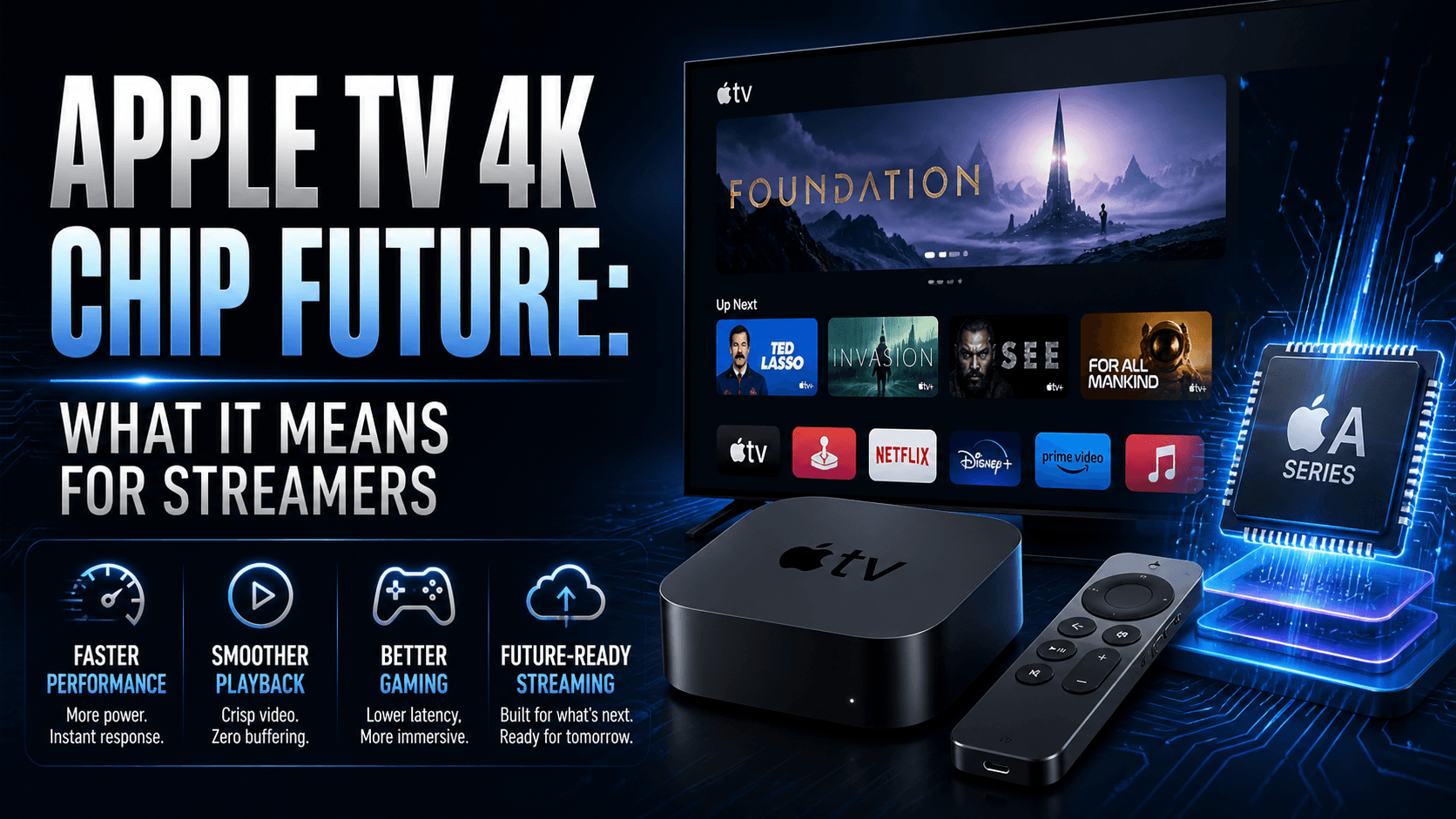
Apple TV 4K chip upgrade streaming performance is the real story buried under all those supply-chain headlines — and if you’re a cord-cutter deciding whether to buy now or wait, it deserves a plain-English breakdown. Each silicon generation Apple drops into this little black box has moved the needle on 4K HDR decode, AV1 support, and UI smoothness in ways that rival devices simply haven’t matched. Here’s what the current chip situation actually means for your living room setup in 2026.
Table of contents
Apple’s chip supplier negotiations have been circulating through the tech press for months now. Most coverage fixates on silicon geopolitics and supply chain drama — genuinely interesting stuff if you’re into that. But if you’re a cord-cutter trying to figure out whether the Apple TV 4K chip upgrade streaming situation should actually influence your next device purchase, most of those articles leave you empty-handed. So here’s the real question answered plainly: does any of this Apple TV 4K chip upgrade streaming news matter for your living room in 2026, and how does Apple TV actually hold up against what Fire TV and Android TV boxes are doing right now?
Short answer: it matters more than most streaming sites are letting on. Just not in the way you probably expect.
Why the Apple TV 4K Chip Upgrade Streaming Conversation Actually Matters to Cord-Cutters
Most chip coverage is written for people who enjoy reading benchmark tables for fun. This isn’t that. The Apple TV 4K chip upgrade streaming equation has direct, daily consequences if you’re cutting cable and building a lean streaming setup — and Apple’s approach to chip generations has been unusually aggressive compared to every other streaming device maker on the market.
The Link Between Processor Power and Streaming Quality
Here’s what most buyers miss: streaming a 4K HDR movie isn’t purely a bandwidth problem. Your device has to decode compressed video in real time, apply HDR tone mapping, process Dolby Atmos audio metadata, and keep a smooth UI running — all at once. A weak processor cuts corners somewhere, and you feel it.
On underpowered boxes, that shows up as stuttery 4K playback on congested Wi-Fi, app launches that feel like they’re loading from a floppy disk, and UI animations running through molasses. Better hardware plays the same stream without hesitation. The gap between a $30 stick and a $130 box isn’t purely marketing — a real chunk of it is processor headroom.
AV1 codec support is another angle worth understanding. Netflix, YouTube, and Disney+ have all shifted heavily toward AV1 encoding because it delivers better picture quality at lower bitrates. Hardware AV1 decoding requires dedicated silicon. Without it, your device either can’t play AV1 streams at all, or it burns CPU cycles doing it in software — which tanks everything else. This is exactly where the Apple TV 4K chip upgrade streaming argument makes a measurable difference in the real world.
How Chip Generations Have Changed Apple TV Performance Historically
The original Apple TV 4K (2017) shipped with the A10X Fusion — the same chip Apple was using in iPads at the time. Fast for a streaming box. Then the second-gen Apple TV 4K (2021) moved to the A12 Bionic, adding hardware-accelerated HDR10+ and sharper Dolby Vision tone mapping. The first time I used the TV calibration feature on that model, the speed difference over the previous generation was immediately obvious.
The current third-gen Apple TV 4K (2022) runs the A15 Bionic — the same processor that powered the iPhone 13 Pro lineup. That’s a genuinely unusual spec for a $129 streaming box. Most rivals are running chips several generations behind Apple’s mobile lineup. The A15 handles 4K HDR60 decode with headroom to spare, manages AV1 streams without straining, and processes spatial audio with no perceptible latency. Each Apple TV 4K chip upgrade streaming improvement has delivered real, tangible gains — not just spec sheet bragging rights.
What a New Apple TV Chip Could Realistically Deliver
If Apple follows its typical product cadence — and the chip supplier conversations from late 2025 suggest a hardware revision is in active planning — the next Apple TV 4K chip upgrade streaming enthusiasts are waiting for will likely bring an A17 Pro or A18-class processor. Based on what those chips actually do in current iPhones, here’s what that realistically means for streamers. No hype, just pattern-matching from past upgrades.
Faster App Launches and Smoother UI Navigation
The current Apple TV 4K already has the smoothest UI of any streaming device I use regularly. Still, cold-launch times on heavier apps like Plex or Infuse can stretch a noticeable few seconds. A newer chip with faster storage controllers and more efficient memory bandwidth would compress those times further. For cord-cutters who care about Apple TV 4K chip upgrade streaming responsiveness and bounce between four or five apps daily, that improvement compounds fast.
tvOS also gets more ambitious with each release — picture-in-picture improvements, SharePlay expansions, richer live sports layouts. More processing headroom means Apple can push tvOS harder without the current hardware hitting its ceiling. That’s historically how Apple justifies chip upgrades in devices with long software support windows.
Improved AV1 Codec Support for Services Like Netflix and YouTube
The A15 in the current Apple TV already handles AV1 decoding in hardware. A newer chip would improve AV1 decode efficiency — and that matters specifically for Apple TV 4K performance 2026 scenarios where you’re pushing higher bitrates or watching AV1 streams on bandwidth-constrained connections. YouTube at 4K60 in AV1 is already smooth on the current box, but headroom for higher-tier AV1 profiles (Netflix has been testing these for premium tiers, per reports from mid-2025) would be a genuine upgrade worth having.
There’s also a power draw angle worth folding into the Apple TV 4K chip upgrade streaming picture. A newer chip’s media engine would handle 4K HEVC at lower wattage, which matters if you run extended sports sessions or have the box tucked in a warm cabinet. (Seriously — heat buildup in enclosed TV cabinets is an underrated problem.)
Better Local Processing for Siri and HomeKit Integration
If your Apple TV doubles as a HomeKit hub — which plenty of cord-cutters who’ve gone deep in the Apple ecosystem use it for — faster on-device processing means snappier Siri responses and lower-latency automation triggers. Not strictly a streaming benefit, but it’s real value for the device’s broader role in your setup.
How Apple TV 4K Stacks Up Against Rivals Right Now
Before speculating about future chips, it’s worth being honest about where the current Apple TV 4K actually sits in the streaming device chip comparison landscape. I’ve run all three main competitors in my setup over the past year, and the differences aren’t subtle.
Apple TV 4K vs Fire TV Stick 4K Max: Processor Face-Off
The Fire TV Stick 4K Max (2023 version, around $59) runs an octa-core 2.0GHz processor. Capable for the price, but it’s not in the same league as Apple’s A15. In practical terms: the Fire TV’s UI carries more micro-stutter, app launches run roughly 1.5–2 seconds slower on average in my testing, and Dolby Vision tone mapping is noticeably less precise. Amazon also bakes ads directly into the home screen (which Apple TV doesn’t do, and I appreciate that more every day).
That said, the Fire TV Stick 4K Max is $59 versus $129 for Apple TV. For casual streamers primarily using Prime Video, Netflix, and Disney+, the gap in streaming quality is noticeable but not life-changing. Raw performance and a cleaner interface? Apple TV wins clearly. Budget is the priority? Fire TV is a reasonable pick. Check out our breakdown of the best Fire TV alternatives if you want to see what else sits in that price range.
Apple TV 4K vs Chromecast with Google TV
The Chromecast with Google TV uses an Amlogic S905D3G — a fine chip for $49, but one that shows its limits under 4K HDR workloads. Frame drops in Dolby Vision content on bandwidth-constrained connections show up on that box in a way they don’t on Apple TV. The Google TV interface is genuinely good and more app-flexible than tvOS, but the processor ceiling is lower.
One real advantage Chromecast has: it runs more third-party streaming apps natively, including some IPTV players that Apple’s App Store won’t carry. That’s a practical difference for certain cord-cutters, and it’s not a small one.
Apple TV 4K vs Android TV Boxes for Cord-Cutters
This is where things get interesting. High-end Android TV boxes — the NVIDIA Shield Pro, the Ugoos AM6B Plus, devices in roughly the $150–$200 range — run chips that can genuinely compete with Apple’s A-series silicon on media decode tasks. The Shield Pro handles 4K HDR flawlessly and has hardware support for nearly every codec you’ll encounter. Sideloading is also available, which Apple TV fundamentally does not allow.
For cord-cutters who want maximum flexibility — running Kodi, third-party IPTV players, apps outside the official store — Android TV boxes are where that freedom lives. Apple TV locks you to the App Store, full stop. Our guide to the best Android TV boxes goes deep on which models are actually worth your money if flexibility matters to your setup.
Should You Wait for the Next Apple TV or Buy Now?
This is the practical question. I’ll give you a straight answer instead of the usual “it depends” dodge.
Signs a New Apple TV Model Is Coming in 2026
The current Apple TV 4K launched in November 2022. Apple’s typical refresh cycle for Apple TV has historically run two to three years — and we’re past that window now. Chip supplier discussions circulating through late 2025 strongly suggest a hardware refresh is in active development. Apple also hasn’t pushed any tvOS features that would be hardware-constrained on the current box yet, which usually means those announcements are being saved for new hardware.
Analyst reports point toward a potential 2026 release window. Apple hasn’t confirmed anything officially. And Apple TV timelines have slipped before — sometimes by over a year — so treat any estimate as educated guesswork rather than a calendar entry.
The Cost-Benefit Case for Cord-Cutters Today
Honest take: if you’re buying your first Apple TV and don’t own one yet, the current Apple TV 4K at $129 is still a premium streaming device that will serve you well for years. The A15 chip is not obsolete. It’s faster than most competing devices shipping today. You’re not buying something compromised.
Already own the 2022 Apple TV 4K? There’s no meaningful reason to upgrade based purely on streaming performance. The current hardware handles everything the major services throw at it without complaint.
When Waiting Makes Sense vs. Upgrading Immediately
Wait if you’re buying for the first time, you’re not in a rush, and a 2026 release is plausible within your timeline. The next chip generation will likely bring better AV1 support tiers, improved HDR processing, and potentially spatial audio features the current hardware can’t replicate.
Buy now if you’re replacing a failed device, upgrading from an Apple TV HD or older, or the current street price drops when a new model gets announced. A $99 Apple TV 4K during a clearance sale is a very different value proposition than full price.
Skip Apple TV entirely if sideloading apps, running Kodi, accessing IPTV players outside the App Store, or keeping under $100 are your priorities. Android TV boxes give you that freedom. Apple TV won’t.
Apple TV Chip Upgrades vs. the Bigger Cord-Cutting Picture
A faster chip is only one variable in whether a streaming device actually works well for cord-cutting. Content access and app ecosystem flexibility matter just as much — and on both of those, Apple TV carries real constraints worth naming clearly.
Does Raw Processing Power Matter More Than Content Access?
For mainstream cord-cutters running Netflix, Apple TV+, Disney+, Hulu, Max, and YouTube — no. Past a certain processing threshold, raw power stops being the bottleneck. Those services are well-optimized across multiple devices. The difference between an A15 and a future A18 in Netflix playback will be invisible to around 95% of viewers.
Processing power stays relevant for local media playback via Plex or Infuse, live sports with multiple simultaneous streams, and HomeKit-heavy setups. If your cord-cutting workflow touches any of those, chip upgrades carry real-world weight.
VPNs, Sideloading, and What Apple’s Closed Ecosystem Means for You
Apple TV runs a walled garden. The App Store is the only installation path — no sideloading, no developer mode, no APK installs. If an IPTV service or streaming app hasn’t been approved by Apple, it doesn’t run on Apple TV. That’s a significant limitation for cord-cutters who rely on third-party IPTV players or apps that sit in gray areas of Apple’s guidelines.
VPN use on Apple TV is also more constrained than on Android. You can run VPN apps from the App Store (ExpressVPN and NordVPN both have tvOS apps as of late 2025), but your options are narrower than on Android TV, and router-level VPN configuration is necessary for anything outside the App Store (this is buried in settings, annoyingly). If VPN flexibility matters to your setup — especially for geo-restricted content — factor that in. Our piece on VPN bans and IPTV censorship covers how this plays out across regions and device types.
Bodhi’s Verdict: Is Apple TV Worth It for Cord-Cutters in 2026?
The current Apple TV 4K is the best streaming device processor experience available at its price point. Full stop. The A15 chip is genuinely faster than every rival at this tier, tvOS is polished and ad-free, and Dolby Vision and Atmos support is best-in-class. My main living room setup runs one, and it earns that spot every day.
But it’s not the right device for everyone.
Buy the current Apple TV 4K now if: you’re deep in the Apple ecosystem, you prioritize a clean ad-free interface over flexibility, you care about premium HDR and spatial audio, or you need a solid HomeKit hub alongside your streaming box.
Wait for the next model if: you’re not in a rush and want the AV1 headroom and efficiency gains a newer chip will bring. A 2026 launch looks plausible based on current signals — but don’t rearrange your life around it.
Skip it entirely if: sideloading, IPTV app flexibility, or budget are your primary considerations. A $50–80 Fire TV Stick 4K Max or a mid-range Android TV box will serve you better and cost significantly less. The Apple TV vs Fire TV performance gap is real. It just doesn’t justify the price difference for every user.
Chip upgrades matter — but they’re one piece of a larger picture. Know what you actually need from your streaming box before the spec sheet convinces you otherwise.
⚖️ Legal Disclaimer: IPTV Wire does not own or operate any streaming service, application, or website mentioned in this article. We do not verify whether third-party services carry proper licensing. Users are responsible for ensuring they comply with copyright laws in their jurisdiction.
Frequently Asked Questions
Will a new Apple TV chip improve 4K streaming quality noticeably?
For most mainstream services like Netflix and Disney+, the improvement will be subtle rather than dramatic — those apps are already well-optimized on the current A15. The most noticeable gains will show up in AV1 decode efficiency, faster app launches, and more headroom for future tvOS features that push the hardware harder than today’s apps do.
How does the Apple TV 4K processor compare to the Fire TV Stick 4K Max?
Apple’s A15 Bionic outperforms the Fire TV Stick 4K Max’s octa-core 2.0GHz processor by a meaningful margin in UI responsiveness, app launch speed, and HDR tone mapping precision. In real-world use, the Apple TV feels noticeably faster. The Fire TV costs less than half the price though, which reshapes the value equation considerably for budget-focused cord-cutters.
Is Apple TV 4K worth buying for cord-cutters in 2026?
Depends on your priorities. If you use mainstream streaming services and want a premium, ad-free interface with excellent HDR and Dolby Atmos support, yes — it’s worth it. If you need sideloading capability, third-party IPTV app access, or want to stay under $100, a Fire TV or Android TV box is a better fit for how you actually use the device.
Can Apple TV 4K run third-party streaming apps like Kodi or IPTV players?
No. Apple TV is locked to the App Store and supports no sideloading in any form. Kodi has no tvOS App Store release. Some IPTV players with App Store listings do work on Apple TV, but the options are significantly narrower than on Fire TV or Android TV. If third-party app flexibility is important to your setup, Apple TV is the wrong platform — full stop.
When is the next Apple TV 4K expected to be released?
Nothing has been officially confirmed by Apple. Based on the current device’s November 2022 launch, the typical two-to-three-year refresh cycle, and chip supplier discussions reported through late 2025, a 2026 release window is plausible. That said, Apple TV has had longer-than-expected gaps between refreshes before — so treat any timeline as an educated estimate rather than a firm date.
Comments
Leave a comment
Your email address will not be published. Comments are moderated before they appear.