

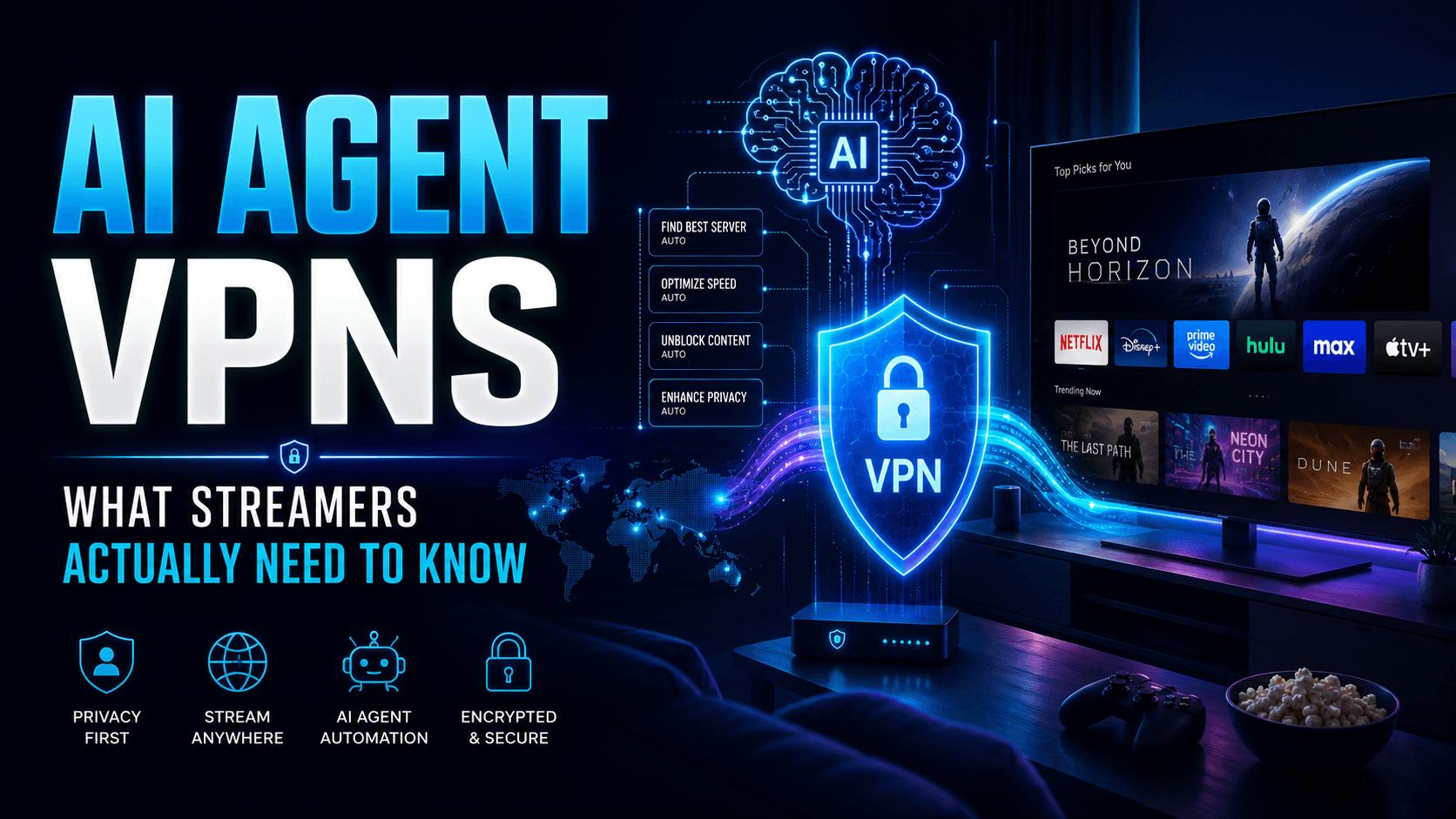
AI VPN for streaming is the phrase dominating tech headlines in 2026, and if you’re a cord-cutter running IPTV on a Firestick or Android box, you’re probably wondering whether any of it actually matters to you. Short answer: some of it does, some of it is rebranded split tunneling, and one specific piece — AI-driven obfuscation — is genuinely worth your attention right now. Let’s cut through the enterprise-IT noise and focus on what changes for real streamers.
Table of contents
The phrase AI VPN for streaming started showing up everywhere after Norton announced their “VPN for AI Agents” product in early 2026. Tech press ran the usual breathless coverage. Most of those articles, though, were written for enterprise IT departments — not someone whose IPTV stream keeps freezing at 9pm on a Friday night. So I want to cut through that noise and answer the question that actually matters for cord-cutters: does any of this AI VPN for streaming technology change anything for you, or is it split tunneling with a flashier name?
Honest answer: it depends entirely on what problem you’re trying to solve. Some of what’s being called “AI-native VPN” is genuinely new. Some of it is old functionality dressed up in new marketing language. And one specific piece — AI-driven obfuscation — is legitimately relevant for IPTV users right now, in a way most coverage completely misses.
What Is an AI-Native VPN (In Plain English)?
You need to understand what the term actually means before deciding whether to care, because the marketing descriptions are designed to confuse rather than clarify.
How Traditional VPNs Work for Streamers
A standard VPN creates an encrypted tunnel between your device and a remote server. All your traffic — every packet — goes through that single tunnel. Your ISP sees encrypted gibberish instead of actual requests. The website you’re visiting sees the VPN server’s IP address, not yours.
For streamers, this solves two problems. It hides your activity from your ISP, which stops throttling on streaming traffic. It also spoofs your location so geo-restricted content becomes accessible. Simple. Effective. The model’s worked for well over a decade.
The downside is everything competes for the same pipe. Your IPTV stream fights for bandwidth against your smart home devices, browser tabs, and whatever else is running in the background. On a busy home network, that single tunnel becomes a real bottleneck during peak hours.
What Makes an AI-Native VPN Different
An AI-native VPN — what the industry is now marketing as an AI VPN for streaming and enterprise use alike — does two things differently. First, it uses machine learning to analyze traffic types in real time and route them intelligently. Second, it creates multiple tunnels simultaneously rather than forcing everything through one pipe.
Think of a highway interchange. Old VPNs give you one lane for everything — semis, sports cars, delivery vans all merge into a single file. A multi-tunnel AI VPN is more like a modern interchange with dedicated lanes: streaming video gets the fast lane with low latency, background AI agent traffic gets its own separate lane, sensitive financial data gets maximum encryption in a third lane.
The AI component decides in real time which traffic goes where. That’s the genuinely new part. Whether any AI VPN for streaming actually works as advertised at scale is a completely different question — and one nobody can fully answer yet.
Do Streamers and Cord-Cutters Actually Need an AI VPN for Streaming?
Here’s where I’ll give you a more honest take than most tech articles bother to provide.
Current VPN Pain Points for IPTV and Streaming
If you’ve been running IPTV on a Firestick or Android box with a VPN, you already know the main issues. Speed overhead is the biggest pain point when using any AI VPN for streaming. Even the best VPNs add some latency, and budget options can cut your throughput by 30–40% — I tested this on a mid-range Android TV box last autumn and the difference was genuinely painful on a 50Mbps connection. Server congestion during peak hours is the second problem; when tens of thousands of users connect to the same London server at 8pm, everyone’s stream degrades.
Geo-blocking is a third pain point, particularly for users accessing streams from providers based outside their country. And increasingly there’s a fourth problem most people don’t talk about enough: ISP-level AI detection of VPN traffic — which is precisely why a proper AI VPN for streaming with obfuscation matters more than ever. Your ISP isn’t just looking at packet volume anymore. They’re using pattern recognition to identify and throttle VPN connections even when they can’t decrypt them.
Where AI Routing Could Genuinely Help
For streaming specifically, intelligent traffic routing is where an AI VPN for streaming has real potential. If an AI VPN correctly identifies that a chunk of UDP packets is a live video stream and prioritizes that traffic over telemetry data from your smart TV’s recommendation engine, that’s a meaningful improvement — not a theoretical one.
Multi-tunnel architecture also addresses something that matters more as our devices get smarter. Your streaming box now runs multiple distinct processes with completely different privacy and performance needs. Your IPTV app, Alexa voice requests, app store updates, and viewing analytics all want different things from the network. Routing them through separate tunnels makes genuine sense.
Where It’s Just Marketing Noise
I’ll be direct. The ‘AI’ label on a VPN product in 2026 often means very little — and slapping ‘AI VPN for streaming’ on a product with mediocre server infrastructure doesn’t fix the underlying problems. If the underlying server infrastructure is mediocre, no amount of machine learning fixes that. If the app doesn’t have a proper kill switch, or crashes on Fire OS 8, the AI routing feature is completely irrelevant.
Norton’s product is new. There are no independent streaming benchmarks yet. Tech press coverage so far is based entirely on the company’s own claims — which, to no one’s surprise, are glowing. Until someone publishes real-world IPTV performance data comparing an AI VPN for streaming to proven options, treat the ‘AI’ label as a potential bonus, not a buying reason.
Multi-Tunnel VPNs vs Single-Tunnel: The Streaming Difference
Speed and Buffering Implications
On paper, multi-tunnel routing in an AI VPN for streaming should reduce buffering for live streams. The logic is sound: separating latency-sensitive video traffic from bulk data transfers lets the VPN allocate resources more efficiently. In practice, this depends entirely on how well the classification algorithm works. Misrouting a stream into a high-encryption tunnel meant for sensitive financial data would actually make buffering worse, not better.
For IPTV specifically — where streams typically run over UDP and need consistent throughput rather than peak speed — intelligent routing that prioritizes that traffic type could meaningfully reduce the dreaded loading spinner. But I’d want to see 30 days of real-world results before recommending anyone switch providers on that promise alone.
If you’re currently dealing with Firestick performance problems that might be VPN-related, check out our guide on Firestick Performance Issues: 7 Proven Solutions 2026 — several of those fixes apply regardless of which VPN you’re using.
Privacy Segregation for AI Tools vs Streaming Apps
This is where multi-tunnel architecture gets genuinely interesting for privacy-focused users. Your streaming box is running more AI processes than most people realize. Recommendation engines, voice assistants, usage analytics — all sending data out constantly, often without you triggering anything deliberately. A multi-tunnel VPN can theoretically isolate that AI agent traffic from your streaming traffic, giving each a different exit IP and a different encryption profile.
That means a third-party data broker watching your network sees different IPs for your IPTV stream and your voice assistant requests. Correlating them becomes significantly harder. For privacy-conscious cord-cutters, that’s not nothing.
Device-Level Routing on Firestick and Android TV
Here’s the practical reality for Firestick and Android TV box users. Most of the sophisticated routing features in AI-native VPNs are controlled at the app level — and that app has to actually work on your device’s operating system. Fire OS is based on Android, but it’s a restricted fork (this causes more headaches than people expect). If the VPN app isn’t optimized specifically for Fire OS, you won’t get the advanced features even if the underlying technology supports them.
Android TV boxes — especially the unlocked ones we cover in our Best Android TV Boxes: 7 Top Models for Streaming 2026 roundup — generally give you more flexibility here, because sideloading access and fewer OS restrictions mean advanced VPN features are more likely to actually function as marketed.
AI Agents Are Everywhere Now — And They Change How VPNs Work
What AI Agents Are Doing in the Background on Your Devices
Your streaming stick or Android TV box isn’t a passive display device anymore. It’s running Alexa or Google Assistant. It’s sending watch history back to recommendation servers. It’s checking for app updates. And if it’s a newer device — a 2024 or 2025 model — it may be running on-device AI features that process audio and visual input locally and then push metadata to the cloud.
Every one of those processes is a network request. Most of them happen without you initiating anything. When you’re watching IPTV at midnight, your box might be simultaneously sending telemetry to five different servers. None of that traffic is encrypted by default. None.
Why AI Traffic Needs Separate VPN Handling
Routing AI agent traffic through the same VPN tunnel as your IPTV stream creates two problems. Performance is the obvious one. Correlation is the subtler and more serious one. If all your traffic exits through the same VPN server IP, a sophisticated observer can potentially link your streaming behavior to your AI assistant queries. For most people, that’s a niche concern. For users in countries with aggressive surveillance infrastructure, it matters enormously.
Multi-tunnel VPN architecture addresses this by assigning different exit points to different traffic types. Your IPTV stream exits through a server in Amsterdam. Your Alexa requests go through a completely different server. The correlation attack becomes exponentially harder to execute.
The Privacy Risk Nobody Is Talking About
Smart TV manufacturers and streaming device makers are increasingly monetizing viewing data. Automatic Content Recognition (ACR) technology scans what’s on your screen and sells that data to advertisers. A standard VPN doesn’t stop ACR — the data is collected at the device level before it ever hits the network. But a VPN with proper DNS leak protection and app-level traffic blocking can prevent that data from reaching the advertiser’s server in the first place.
An AI-native VPN that can identify and isolate ACR telemetry traffic specifically — routing it to a null exit or blocking it entirely — would be genuinely valuable for privacy-focused streamers. Whether current products actually do this is something I’d want to independently verify before making that claim with confidence.
How to Choose an AI VPN for Streaming in 2026
Speed Benchmarks That Matter for IPTV Streams
For IPTV, the metrics that matter aren’t the same ones that matter for downloading files. You need consistent throughput more than peak speed. A VPN delivering a reliable 80Mbps beats one that swings between 200Mbps and 40Mbps with jitter. Look for independent tests that measure latency and jitter specifically — not just the headline download number plastered on the provider’s homepage.
Server load metrics matter too. A VPN with 5,000 servers constantly running at 90% capacity will perform worse than one with 1,000 well-maintained, lower-utilization servers. Some providers publish real-time load data; that transparency is itself a good sign.
AI or Not — Server Count and Location Still Win
Uncomfortable truth: a VPN with excellent server infrastructure and zero AI features will outperform an AI-native VPN with mediocre servers. Every single time. Server proximity to your physical location, server-to-user ratios, and peering agreements with major ISPs determine real-world streaming performance more than any routing algorithm.
When evaluating any VPN for streaming in 2026 — AI-branded or traditional — my starting checklist is always: server count by region, a published no-log policy audited by a credible third party (yes, you really do need to verify this, not just take the provider’s word for it), and whether the Android or Fire OS app has a working kill switch. AI features are a bonus if the fundamentals are solid.
Features to Prioritize on Firestick and Android TV Boxes
On streaming hardware specifically, here’s what I actually look for: dedicated streaming-optimized server profiles, an app that doesn’t crash on Fire OS 8 or Android TV 12, split tunneling support so you can exclude apps that don’t need VPN protection, and a kill switch that genuinely cuts your connection if the VPN drops. Without that last one, your real IP gets exposed every time the VPN hiccups — and on budget Android boxes running older chipsets, that happens more than you’d like.
VPN Censorship, IPTV, and the AI Privacy Shift
How ISPs Are Using AI to Detect VPN Traffic
This is the part of the AI VPN conversation I think is most relevant to IPTV users right now, and it’s getting almost no coverage. ISPs in the US, UK, and Australia are deploying deep packet inspection systems enhanced with machine learning to identify VPN traffic patterns — even when that traffic is fully encrypted. This isn’t speculation; ISPs in the UK have been openly expanding DPI capabilities since around 2023.
Traditional VPN obfuscation makes VPN traffic look like regular HTTPS traffic. But ML-based detection can identify statistical patterns in packet timing, size distribution, and flow behavior that betray a VPN connection even when content is encrypted. This is an arms race. ISPs are well-funded and improving fast.
For a deeper look at how this affects IPTV specifically, our article on VPN Bans & IPTV: How Censorship Affects Your Streams covers the regulatory and technical landscape in detail.
Why AI-Enhanced Obfuscation Matters for IPTV Users
An AI-native VPN that uses machine learning on the client side to dynamically adapt its traffic patterns — making each session look statistically distinct from the last — is a real countermeasure to ISP AI detection. This is where the “AI” label actually earns its place. Not in marketing copy. In the protocol layer.
If your ISP is throttling your VPN connection at peak hours and a standard obfuscation protocol isn’t cutting it, an AI-adaptive obfuscation layer could genuinely help. That’s not marketing noise. That’s a real technical response to a real technical problem IPTV users face daily — and it’s the one AI VPN feature I’d pay a premium for if a provider could demonstrate it actually works.
Bodhi’s Verdict: Wait, Watch, or Buy Into AI VPNs Now?
My honest recommendation for most cord-cutters in 2026: wait and watch — but for specific reasons, not vague skepticism.
The underlying concepts behind AI-native VPNs — multi-tunnel routing, adaptive obfuscation, traffic type segregation — are legitimate, and some of them are genuinely useful for streaming. The problem is that “AI VPN” is currently a marketing category more than a verified performance category. Norton’s product is newly launched. No independent long-term streaming benchmarks exist. The claims haven’t been stress-tested by the IPTV community yet. That matters.
What I’d suggest instead: if your current VPN is failing you — buffering, dropped connections, ISP throttling getting through — check first whether your existing provider has obfuscation modes you haven’t turned on yet (this is buried in settings, annoyingly, on most apps). Most top-tier VPNs added some form of traffic obfuscation years ago. Enable it, test it for a week, and see if that solves your problem before paying a premium for an AI-branded product.
Starting from scratch and choosing a VPN for Firestick or Android TV box use in 2026? Prioritize proven streaming performance, a working Fire OS or Android TV app, and a no-log policy that’s been independently audited. If the provider also offers AI-enhanced routing as part of the package, great — treat it as a bonus, not the headline feature you’re buying.
The AI VPN conversation is going to matter more in six months when real-world performance data actually exists. I’ll be testing and reporting back as that data comes in.
⚖️ Legal Disclaimer: IPTV Wire does not own or operate any streaming service, application, or website mentioned in this article. We do not verify whether third-party services carry proper licensing. Users are responsible for ensuring they comply with copyright laws in their jurisdiction.
Frequently Asked Questions
What is an AI-native VPN and is it better for streaming?
An AI-native VPN uses machine learning to analyze your traffic in real time and route different data types through separate encrypted tunnels. For streaming, it theoretically prioritizes video traffic for lower latency and less buffering. Whether it actually outperforms traditional VPNs in real-world IPTV scenarios hasn’t been independently verified as of mid-2026 — availability of that data varies by region and provider, and most benchmarks so far come from the companies themselves.
Does a multi-tunnel VPN reduce buffering on IPTV streams?
In theory, yes. By isolating your IPTV stream from competing background traffic, a multi-tunnel VPN can reduce the congestion that causes buffering. In practice, this depends heavily on the quality of the traffic classification algorithm and the underlying server infrastructure. Poor classification could actually make buffering worse — misroute your stream into a high-encryption tunnel and you’ll feel it immediately.
Can I use an AI VPN on my Firestick or Android TV box?
You can, as long as the provider offers a compatible app for Fire OS or Android TV. Android TV boxes generally give you more flexibility here, since Fire OS imposes tighter restrictions on background processes. Check that the app actually supports advanced features — kill switch, split tunneling — on your specific device before subscribing. Don’t assume; verify.
Is Norton VPN for AI Agents good for cord-cutters?
Too early to say with confidence. Norton’s product launched in early 2026 and lacks independent streaming performance benchmarks. The technology behind it is sound in principle, but cord-cutters should wait for real-world IPTV performance data before switching from a proven provider. Brand reputation alone isn’t enough justification to make the switch.
How is an AI VPN different from split tunneling?
Split tunneling is a manual feature — you choose which apps use the VPN and which connect directly. An AI-native multi-tunnel VPN automates and extends that concept significantly. The AI classifies traffic types dynamically and routes them through different encrypted tunnels simultaneously, without you manually configuring anything. Think of it as split tunneling that makes its own decisions in real time, rather than waiting for you to set rules up front.
Comments
Leave a comment
Your email address will not be published. Comments are moderated before they appear.