
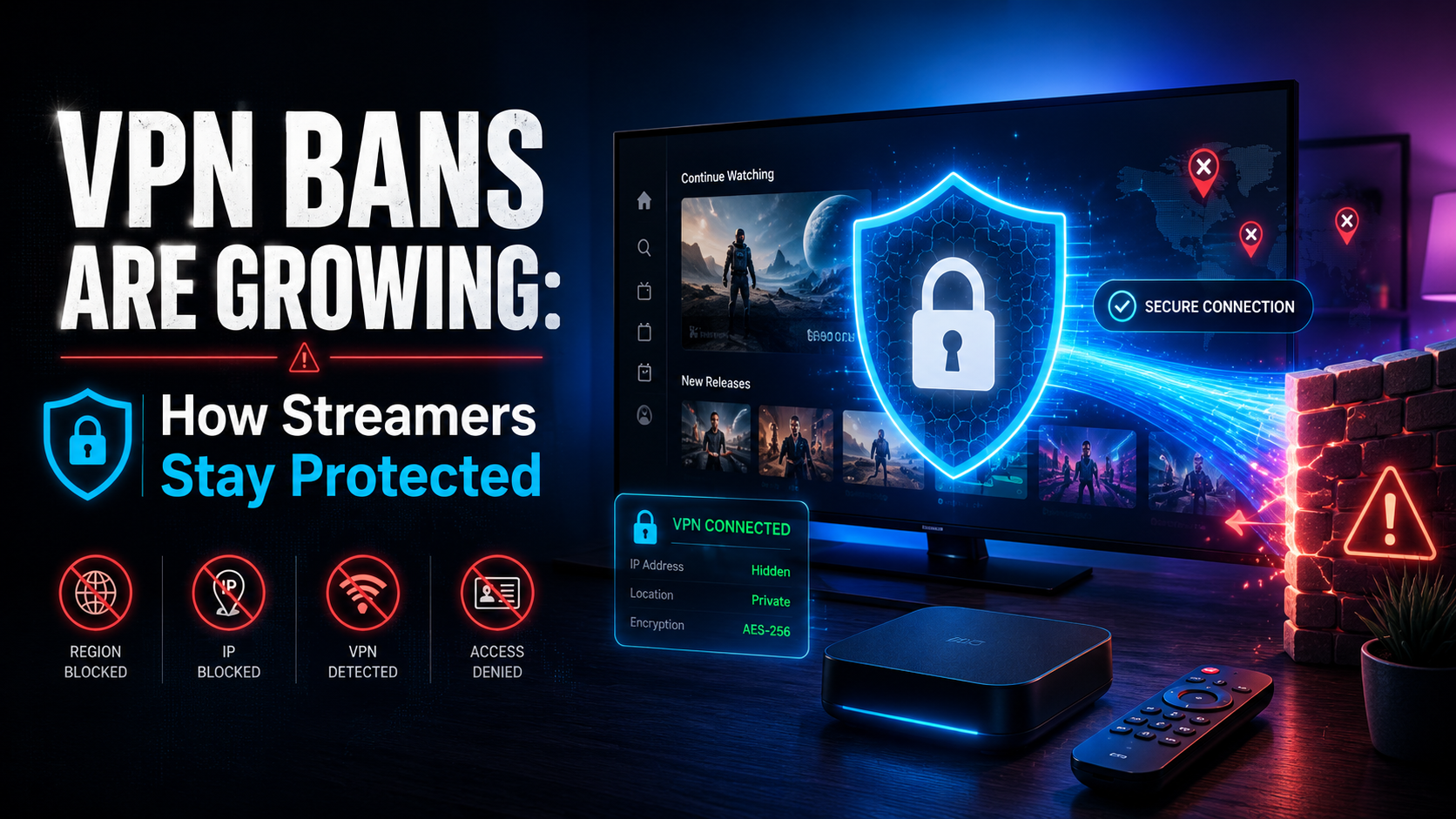
VPN bans and streaming workarounds have quietly become the defining headache for cord-cutters — not just outside the West anymore, but increasingly inside it too. If you rely on a VPN to protect your IPTV setup, unlock geo-restricted libraries, or simply keep your viewing habits private, the landscape has shifted dramatically in the past three years. Governments are no longer just blocking streaming sites — they are targeting the tools people use to reach them. That changes everything.
[TOC]
Why VPN Bans Are a Real Problem for Streamers
VPN bans and streaming workarounds have quietly become the defining headache for cord-cutters — not just outside the West anymore, but increasingly inside it too. Over the past three years, governments have shifted from blocking streaming sites to targeting the tools people use to reach them. That’s a meaningful change. Anyone relying on a VPN to protect their IPTV setup, access geo-restricted libraries, or simply keep their viewing habits private needs to understand what’s actually happening out there.
This stopped being a niche concern a while ago. VPN bans and streaming workarounds are now a daily reality for millions of users — and the pressure is only intensifying as detection technology catches up with the tools streamers depend on — the number of countries with active, enforced VPN restrictions has grown quietly but steadily since around 2021, and the detection technology behind those restrictions has become genuinely sophisticated. If you’re streaming via IPTV or running a VPN on a Firestick or Android TV box, the situation is worth paying close attention to.
Which Countries Are Actively Enforcing VPN Bans and Streaming Workarounds Right Now
As of mid-2026, the short list of countries with active and enforced VPN restrictions includes China, Iran, Russia, the UAE, Turkmenistan, Belarus, and North Korea. Each takes a slightly different approach when enforcing VPN bans and streaming workarounds. China’s ‘Great Firewall’ is probably the most technically advanced censorship infrastructure on earth — arguably the most sophisticated civilian-facing one anywhere. Iran blocks most commercial VPN protocols at the ISP level. The UAE permits VPN use only through licensed corporate providers, meaning personal VPN use for streaming carries real legal risk that could follow you home.
Turkmenistan and North Korea are closer to full internet lockdowns — barely worth discussing in terms of workarounds, honestly. Russia sits somewhere in the middle. VPN blocking has been escalating since roughly 2017, with government pressure on providers to connect to a national blocklist, and enforcement has tightened noticeably since 2022. Belarus blocked dozens of VPN services after the 2020 political crackdown and hasn’t let up.
Traveling to any of these countries? VPN bans and streaming workarounds are active and evolving there — not theoretical risks you can safely ignore while you stream.
How Government-Level VPN Blocking Fuels the Need for Streaming Workarounds
Most people assume VPN bans and streaming workarounds are simple: government tells ISPs to block a website, done. The reality is far more layered, and understanding it is the first step toward actually staying connected. The reality is far more layered. Modern VPN blocking operates on at least three distinct levels — IP blacklisting, port blocking, and Deep Packet Inspection (DPI). ISPs in restrictive countries are often legally required to deploy all three simultaneously.
When you connect to a VPN server, your ISP sees encrypted traffic heading to a specific IP address on a specific port. Standard protocols like OpenVPN and WireGuard have recognizable traffic patterns. DPI equipment — which ISPs in China, Iran, and Russia are legally required to install — can identify those patterns even without decrypting a single byte of your actual data. That’s the core mechanism: it doesn’t need to read your traffic, it just needs to recognize that the traffic looks like VPN traffic. The encryption is essentially irrelevant to this kind of detection.
What This Means for IPTV Users Specifically
IPTV services are among the highest-risk streaming categories in restrictive countries — sitting right at the sharpest edge of VPN bans and streaming workarounds, where government enforcement and rights-holder pressure overlap. Unlike Netflix or YouTube, most IPTV providers have no local licensing agreements — which puts them in a legal gray zone that makes governments even more motivated to block access. When a VPN goes down, IPTV streams don’t just buffer. They go completely dark.
I’ve spoken with readers in the UAE and Iran who lost access to their IPTV subscriptions overnight when their VPN provider’s IP range got blacklisted. Recovery meant switching servers manually — sometimes several times in a single evening. For more context on how censorship specifically affects IPTV access, this breakdown of VPN bans and IPTV censorship covers the streaming angle in detail.
How VPN Blocking Technology Has Evolved
Understanding the technology behind VPN bans and streaming workarounds isn’t just academic — it directly shapes which features are worth paying for and which are pure marketing noise. It directly determines which VPN features you actually need to pay for and which ones are pure marketing fluff. The arms race between VPN providers and government censors — driven entirely by the escalating stakes of VPN bans and streaming workarounds — has been running for roughly fifteen years, producing some genuinely clever countermeasures on both sides.
Deep Packet Inspection (DPI) Explained Simply
Think of DPI as an extremely sophisticated sorting machine your ISP runs at the network level. Normal traffic inspection only looks at the envelope — where a packet came from, where it’s going. DPI opens the envelope and examines the writing style inside, even if the words themselves are scrambled. VPN traffic has a recognizable “writing style”: specific handshake patterns, packet size distributions, timing signatures. A DPI system can flag all of that without decrypting anything.
Consumer-grade DPI hardware costing around $50,000 per unit can now process multi-gigabit streams in real time. ISPs in China, Iran, and Russia operate this equipment at scale — which is exactly why VPN bans and streaming workarounds have become an arms race rather than a simple cat-and-mouse game. Simply encrypting your traffic stopped being enough protection around 2015 — that’s not an estimate, it’s roughly when the Great Firewall started reliably catching standard OpenVPN connections. Understanding this history is essential context for anyone researching VPN bans and streaming workarounds today.
IP Blacklisting vs Protocol Fingerprinting
IP blacklisting is the older, blunter method in the broader toolkit of VPN bans and streaming workarounds. Governments maintain lists of known VPN server IP addresses — pulled from public provider databases, crowdsourced reports, and active scanning — and instruct ISPs to drop all traffic heading there. This is why major providers constantly rotate their server IP ranges. It’s an ongoing whack-a-mole situation with no end in sight.
Protocol fingerprinting is more surgical. Instead of blocking a specific IP, the censorship system identifies and drops the traffic type regardless of destination. WireGuard, OpenVPN UDP, and IKEv2 each have distinct fingerprints. Once a government trains its DPI systems on those fingerprints, every connection using that protocol gets throttled or dropped — even to IP addresses that haven’t been blacklisted yet. This is exactly what makes China’s approach so hard to circumvent with standard VPN configurations out of the box.
Why Standard VPN Protocols Fail in Censored Regions
WireGuard is fast and efficient. That’s also precisely why it’s easy to identify — the traffic pattern is distinctive enough to flag reliably. OpenVPN over TCP looks more like HTTPS traffic but still carries recognizable signatures that advanced DPI catches. IKEv2 is blocked outright in most restrictive countries. Even PPTP — outdated, insecure, and barely used anymore — gets blocked because it’s been on government blacklists since around 2013.
The practical upshot: if you’re in a country with active VPN censorship and you’re running a standard NordVPN or ExpressVPN connection without enabling any anti-censorship features, expect the connection to fail or get throttled within minutes. Sometimes seconds.
Streaming Devices Most Vulnerable to VPN Crackdowns
This is the angle most coverage misses entirely. VPN bans and streaming workarounds aren’t just a software problem — they play out differently depending on which hardware is sitting next to your TV. Your streaming device determines how easily you can install a backup VPN, switch protocols under pressure, or recover when an app disappears from the store.
Firestick Users: What Changes If Your VPN Gets Blocked
Amazon has already pulled several VPN apps from its Appstore, either due to government pressure in specific regions or policy enforcement against apps that facilitate access to unlicensed content. If you’re in a region where Amazon runs a localized Appstore, the VPN apps available to you may be a substantially shorter list than what US-based users see. I noticed this firsthand when traveling — the regional store had maybe four VPN options versus dozens in the US store.
The risk for Firestick users is twofold. First, your primary VPN app might stop working if its protocol gets blocked. Second, you might lose the ability to install an alternative through official channels. Sideloading via the Downloader app is the most reliable fallback — here’s how Downloader App codes work and how to use them to pull APKs directly to your Firestick without going through Amazon’s store at all.
Android TV and Google TV: Sideloading Risks
Android TV and Google TV devices have a broader sideloading ecosystem than Firestick. That’s an advantage, but also a complication. The Google Play Store has removed VPN apps in certain countries under local government pressure — this happened with multiple providers in India in 2022 and in Russia during the same period. Users who hadn’t already sideloaded a backup APK were left scrambling.
Android TV boxes running stock firmware are generally easier to sideload on than Fire OS devices, but that’s not universal. Some OEM-locked Android TV boxes — particularly budget models sold through local carriers in South and Southeast Asia — restrict package installation from unknown sources at the firmware level (buried deep in the settings, annoyingly). Check this before you assume sideloading is possible.
Smart TVs with Built-In App Stores: The Hidden Danger
Honestly, this is the most overlooked vulnerability in the whole VPN conversation. Samsung Tizen TVs, LG webOS TVs, and Hisense VIDAA TVs all run proprietary operating systems with curated app stores that have extremely limited VPN selections to begin with. When a government tells Samsung or LG to remove a VPN app from its regional store, those companies almost always comply — quietly, with no announcement.
If your only streaming device is a smart TV with a built-in OS, you have almost no fallback options when VPN access gets restricted. Sideloading isn’t possible on most of these platforms. That’s the hidden danger — and it’s a strong argument for pairing any smart TV setup with a dedicated streaming stick or box that gives you actual control over what gets installed.
VPN Features That Actually Bypass Government Blocks
Not all VPN features are equal when it comes to defeating censorship. Marketing pages are full of “military-grade encryption” and “no-log policy” — both useful, but neither will help when your ISP’s DPI system is blocking your traffic at the protocol level. Here’s what actually matters.
Obfuscation / Stealth Mode: What It Is and Why It Matters
Obfuscation — marketed variously as “stealth mode,” “traffic disguise,” or sometimes just buried in advanced settings — is the single most important feature for streamers in restrictive environments. It works by wrapping VPN traffic inside what looks like ordinary HTTPS web browsing. To a DPI system, an obfuscated connection looks like someone visiting a normal website. There’s no VPN fingerprint to match against.
ExpressVPN’s Lightway protocol includes built-in obfuscation, accessible without digging through menus. NordVPN offers obfuscated servers specifically labeled as such, but you need to switch to them manually in the settings — a small but real friction point if you’re in a hurry. Astrill VPN has a strong reputation for obfuscation performance in China specifically, though it runs around $15–$30/month depending on plan, which is noticeably more expensive than most competitors.
For a broader comparison of VPN options that balance price with these features, check out this guide to VPNs that are actually safe for streamers in 2026.
Shadowsocks and V2Ray Protocols for Streamers
Shadowsocks was originally developed by a Chinese programmer specifically to circumvent the Great Firewall. It remains one of the most effective tools for getting around DPI-based censorship. It’s a SOCKS5 proxy protocol that disguises traffic as ordinary HTTPS — and unlike full VPN obfuscation, it runs lighter on device resources. That matters on a Firestick or a budget Android TV box where every CPU cycle counts during HD playback.
V2Ray is a more sophisticated successor that supports multiple transport protocols and can route different types of traffic differently. Mullvad is a notable example of a provider offering V2Ray as a transport option in its desktop client, though TV and mobile support is spottier depending on the version. If you’re in a high-censorship environment and streaming is your primary use case, look specifically for VPN providers that mention Shadowsocks or V2Ray by name — not just “obfuscation” as a vague marketing term.
Multi-Hop and Split Tunneling Strategies
Multi-hop routing sends your traffic through two VPN servers in different countries before it reaches its destination. Your ISP sees traffic leaving your device going to Server A. It doesn’t know Server A is forwarding everything to Server B, which then connects to your IPTV stream. This adds latency — expect roughly 20–50ms extra on a well-configured setup — but it significantly raises the difficulty of blocking your connection without causing collateral damage to other traffic.
Split tunneling does something different. It routes only specific apps through your VPN while the rest of your traffic goes through your normal connection. On a streaming device, this means routing your IPTV app through the VPN while letting YouTube updates and general browsing go through your regular ISP connection. Less VPN traffic for your ISP to analyze means a lower chance of pattern-matching systems flagging your connection. It’s not foolproof, but it reduces your exposure.
How to Future-Proof Your Streaming Setup Against VPN Bans
Knowing what’s coming is only useful if you act before the problem arrives. These are the specific steps I’ve taken on my own home setup — and what I’d recommend to anyone who relies on IPTV or geo-restricted content regularly.
Always Have a Backup VPN Protocol Ready
Don’t rely on a single protocol. Open your VPN app settings right now and check which alternative protocols are available. Test them while everything is still working. If WireGuard is your default, know exactly how to switch to OpenVPN TCP or your provider’s obfuscated mode in under 60 seconds. When a block hits, there’s no time to read a tutorial.
My setup at home includes a written cheat sheet — yes, physical paper — taped near the router with manual server addresses and protocol settings for two VPN providers. It sounds old-fashioned, but when you’re troubleshooting a dead stream at 10pm and the VPN app itself won’t load, you’ll be glad you have it.
Use a VPN Router for Whole-Home Coverage
A VPN-configured router solves the device-specific app problem entirely. Your Firestick, smart TV, gaming console, and every other device on your network all route through the VPN without needing individual apps. If an app gets pulled from an app store, it simply doesn’t matter — the device doesn’t need a VPN app because the router handles everything upstream.
Asus routers running Merlin firmware and GL.iNet travel routers both support OpenVPN and WireGuard natively. Some GL.iNet models — the GL-AXT1800 and GL-MT3000, for example — support Shadowsocks out of the box. Setup takes around 30 minutes once, then runs silently in the background. Worth every minute.
Keep Sideloaded VPN APKs Offline as a Backup
Here’s a tip I haven’t seen mentioned elsewhere explicitly: download VPN provider APK files directly from the provider’s official website and save them to a USB drive or cloud storage right now, before any restrictions hit. If your VPN app disappears from the Amazon Appstore or Google Play tomorrow, you’ll still have an installable file ready to go (yes, you really do need to do this before the problem happens, not after).
APK files don’t expire. One you downloaded today will still be installable on your Firestick six months from now via Downloader or any file manager app. Store at least two — your primary VPN and a backup provider — and check every few months that the version you’ve saved still connects to current server infrastructure. Providers occasionally deprecate old app versions when they upgrade their backend.
Should You Be Worried If You’re in the US, UK, or Canada?
Honestly? Not urgently. But paying attention costs nothing. VPN use is fully legal in the United States, United Kingdom, Canada, and across the EU. No Western government has moved toward banning consumer VPNs, and there’s no credible signal that’s changing in the near term.
Current Legal Status of VPNs in Western Countries
In the United States, VPNs are legal for any lawful purpose. The UK is identical. Canada has no VPN restrictions whatsoever. Australia, New Zealand, and most of Western Europe follow the same framework. Using a VPN to access another country’s streaming library sits in a gray area under platform terms of service, but it’s not a criminal matter in any of these jurisdictions — and streaming platforms haven’t pursued legal action against individual users for it, as far as any public record shows.
App Store Removals: A Softer Form of VPN Censorship
Here’s where it gets more interesting. Apple removed hundreds of VPN apps from the Chinese App Store in 2017 at the direct request of the Chinese government — a decision that drew widespread criticism at the time. That compliance mechanism exists everywhere Apple operates. If a Western government issued a formal demand to remove specific VPN apps from regional stores, the infrastructure to do so already exists and has already been used.
Google similarly complied with government-mandated app removals in India and Russia, both in 2022. This isn’t speculation — it’s documented. The practical lesson for Western streamers: don’t assume your VPN app will always be available through official channels. Knowing how to sideload is a useful skill regardless of where you live.
What Precedents Abroad Could Mean Closer to Home
The pressure on VPN providers isn’t only coming from authoritarian governments. Copyright enforcement bodies in the EU have pushed for VPN providers to block access to piracy-linked IP address ranges. That’s a narrower ask than a full ban, but it uses the same underlying technical infrastructure. Regulatory frameworks that require VPN providers to maintain logs, comply with law enforcement requests, or block certain traffic categories are already under active discussion in multiple democratic countries — the UK’s Online Safety Act and the EU’s ongoing platform regulation debates both touch adjacent territory.
None of this is reason to panic. It is reason to understand your tools well enough that you’re not caught flat-footed if the landscape shifts — even gradually.
⚖️ Legal Disclaimer: IPTV Wire does not own or operate any streaming service, application, or website mentioned in this article. We do not verify whether third-party services carry proper licensing. Users are responsible for ensuring they comply with copyright laws in their jurisdiction.
Frequently Asked Questions
Are VPNs being banned in the US or UK for streaming?
No. VPNs are fully legal in both the United States and the United Kingdom as of mid-2026. There are no active government restrictions on consumer VPN use in either country. The concern is primarily relevant to users in countries like China, Iran, the UAE, Russia, and Belarus, where VPN access is restricted or heavily regulated — and to travelers heading to those regions.
What VPN features help bypass government blocking?
The most important features are obfuscation (also called stealth mode), support for Shadowsocks or V2Ray protocols, and multi-hop routing. These tools disguise VPN traffic so it resembles normal web traffic to Deep Packet Inspection systems used by ISPs in censored countries. Standard protocols like WireGuard and OpenVPN, without obfuscation enabled, are routinely blocked outright in high-censorship regions. Availability of these features varies by provider and sometimes by app version, so check before you commit to a subscription.
Can I still use IPTV if my VPN gets blocked?
Possibly — it depends on why the block is happening and what alternatives you have ready. If your VPN app is still installed but one specific protocol is blocked, switching to an obfuscated protocol or Shadowsocks may restore access quickly. If your VPN provider’s entire IP range has been blacklisted, you’ll need to switch providers or server locations. The most reliable contingency is having a backup VPN APK already sideloaded on your device before the problem occurs, not after.
What is obfuscation and do I need it for streaming?
Obfuscation disguises VPN traffic as ordinary HTTPS web traffic, making it unrecognizable to Deep Packet Inspection systems. If you’re streaming in the US, UK, Canada, or most of Western Europe, you almost certainly don’t need it — standard protocols work fine in unrestricted environments. If you’re in or traveling to a country with active VPN restrictions, obfuscation isn’t optional. It’s often the difference between having a working connection and not having one at all.
Which streaming devices are most affected by VPN bans?
Smart TVs running proprietary operating systems — Samsung Tizen, LG webOS, Hisense VIDAA — are the most vulnerable. They have almost no sideloading capability, so if a VPN app gets removed from their curated store, you’re out of options on that device with no real workaround. Firestick and Android TV boxes are considerably more resilient because they support sideloading via tools like the Downloader app, letting you install VPN APKs directly without relying on any official store. If you’re serious about staying connected, pair your smart TV with a dedicated streaming stick or box that actually gives you that flexibility.
