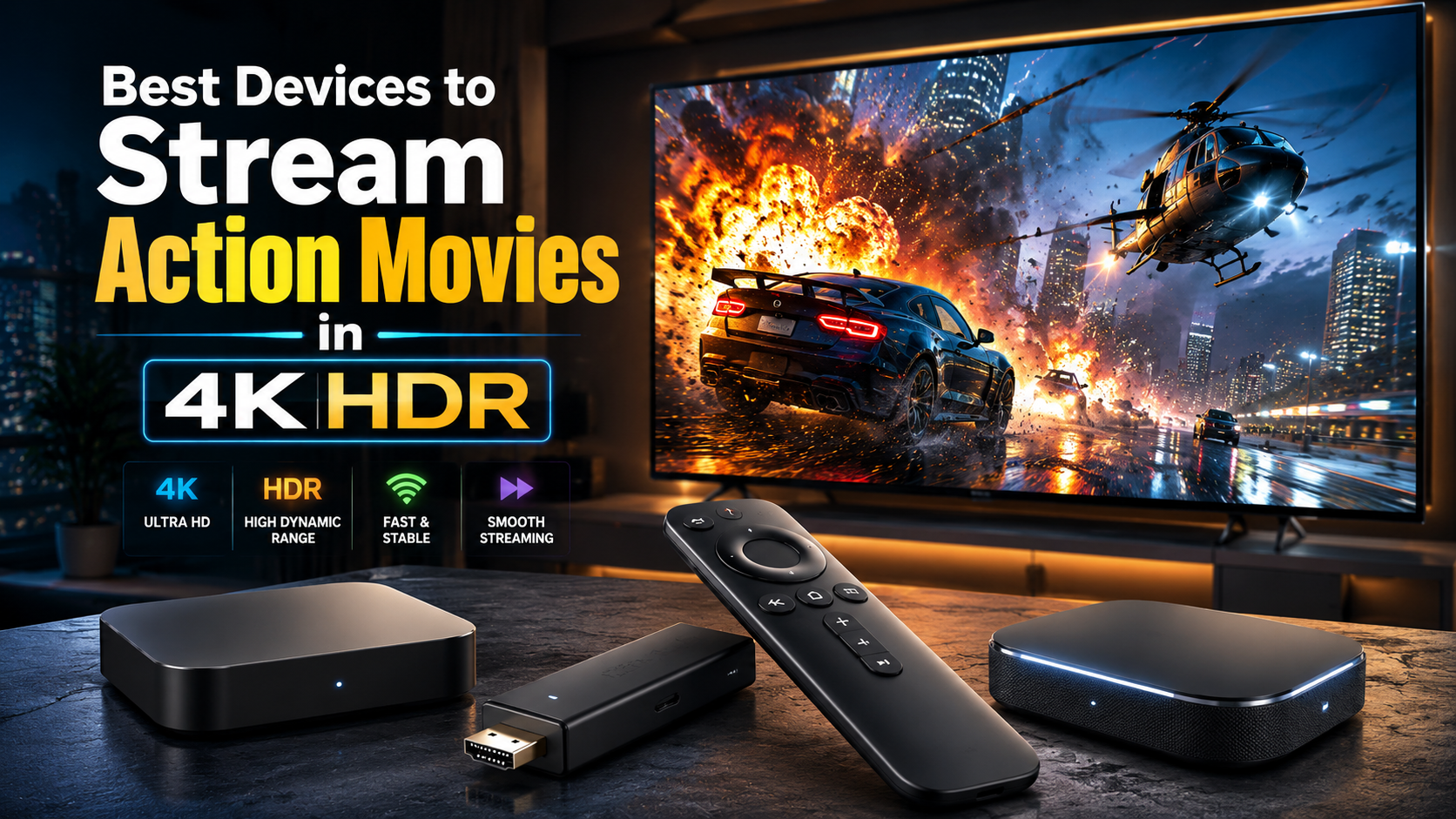
Best devices for streaming 4K action movies in 2026 are the single biggest variable between a jaw-dropping cinematic experience and a blurry, stuttering mess — and the gap between budget sticks and premium boxes has never been wider. This guide cuts through the spec-sheet noise to tell you exactly which hardware decodes Dolby Vision cleanly, holds frame rate steady through the most chaotic high-bitrate sequences, and delivers lossless Atmos audio without compromise.
[TOC]
Ever wondered why the best devices for streaming 4K action movies matter so much? Ever watched a massive explosion sequence turn into a pixelated smear halfway through? Or seen a high-speed car chase go soft and blurry right when the editing kicks into overdrive? You already know the problem. The best devices for streaming 4K action movies in 2026 aren’t just boxes that output a 4K signal — they decode complex HDR metadata, hold frame rate steady through chaotic scene changes, and push clean Atmos audio to your soundbar without breaking a sweat. Getting all three right simultaneously takes real hardware — and that is precisely what separates the best devices for streaming 4K action movies from the pretenders. This guide tells you exactly which devices pull it off.
I tested all six of the best devices for streaming 4K action movies on the same 65-inch LG C3 OLED, running off the same 500Mbps fiber line, using the same mix of content: high-bitrate action titles from major streaming services, local 4K Remux files through Plex, and a handful of IPTV channels pushing 4K HDR feeds. Some differences were subtle. Others were night and day.
Why Your Streaming Device Matters for 4K Action Content
Most people assume the TV does all the heavy lifting when hunting for the best devices for streaming 4K action movies. It doesn’t. When you’re using the best devices for streaming 4K action movies, your streaming stick or box has to fetch, decode, tone-map, and hand off the video signal before your television ever touches it. With standard HD content, almost any device handles that gracefully. At 4K HDR — especially during the kind of chaotic, fast-cut sequences that define action films — processing demands spike hard and fast.
HDR Formats Explained: Dolby Vision vs HDR10+ vs HLG
HDR10 is the baseline open standard. Every 4K HDR device supports it. It applies static metadata, meaning brightness and color grading is set once for the entire film. Fine for slower, dialogue-heavy content. Less impressive when the lighting swings wildly scene to scene.
Dolby Vision and HDR10+ both use dynamic metadata — adjusting tone mapping scene by scene, sometimes frame by frame. For action movies, this matters enormously. Think about the cut from a sun-scorched rooftop chase to a pitch-black underground tunnel: dynamic metadata lets the display recalibrate for each moment rather than averaging across the whole film. Dolby Vision has broader support across streaming apps; HDR10+ has stronger backing from Amazon and Samsung specifically.
HLG (Hybrid Log-Gamma) is mostly a live broadcast format. If you’re watching 4K HDR sports or live events through an IPTV player, HLG support matters more than most people expect — especially for IPTV streams that originate from broadcast feeds.
Why Processing Power Affects Fast-Motion Clarity
Cheaper streaming sticks — definitely not among the best devices for streaming 4K action movies — use underpowered chips that genuinely struggle to decode high-bitrate H.265 (HEVC) or AV1 streams in real time. Choosing the right hardware here is non-negotiable. When a 4K action scene hits a sustained bitrate spike — a massive car chase with motion blur and particle effects running simultaneously — a weak processor starts dropping frames or over-compressing on the fly. The result looks like soft, smeared motion even on a premium panel. More RAM lets the device buffer larger video chunks ahead of time — a key reason the best devices for streaming 4K action movies all ship with at least 3GB — smoothing out those bitrate spikes before they become visible artifacts.
Top Picks: Best Devices for Streaming 4K Action Movies Ranked
Here’s where I actually rank the best devices for streaming 4K action movies based on real-world performance, not spec sheets alone.
NVIDIA Shield Pro: The Gold Standard
The NVIDIA Shield Pro is still the most capable streaming device money can buy heading into 2026. Its Tegra X1+ processor handles every relevant HDR format — Dolby Vision, HDR10+, HDR10, HLG — without any visible strain. The built-in AI upscaling is genuinely impressive. I ran a 1080p action title through it and the upscaled output was cleaner than some native 4K streams I’ve seen on budget devices. Throw in Dolby Atmos passthrough, a Gigabit Ethernet port, and expandable storage, and nothing else touches it at the performance ceiling.
The catch: it runs around $199. The Android TV interface also feels dated compared to Google TV — a real usability gap in 2026. For pure 4K HDR performance during demanding action content, though, the Shield Pro is in its own class.
Amazon Fire TV Stick 4K Max: Best Bang for Buck
The Fire TV Stick 4K Max (2nd Gen) runs a 2.0GHz octa-core processor with 3GB of RAM, supports Dolby Vision, HDR10+, HDR10, and HLG, and has Wi-Fi 6E built in. At around $59 — and frequently on sale for less — it punches well above its price class. I’ve had it running 4K Dolby Vision content for multi-hour sessions with zero buffering on a Wi-Fi 6 network.
The Fire TV interface is heavily ad-supported, which gets old fast. Sideloading apps (including solid IPTV players) is straightforward though (yes, you really do need to enable this in the developer settings). If you’re already in the Amazon ecosystem, the value proposition is hard to argue with. Check out our breakdown of Best Amazon Fire TV Bundles: Are They Worth It in 2026? if you’re weighing a bundle deal.
Apple TV 4K (3rd Gen): Best for Apple Ecosystem
The Apple TV 4K (3rd Gen) runs Apple’s A15 Bionic chip — the same silicon that powered the iPhone 13 Pro. It handles Dolby Vision, HDR10, and HLG, and color accuracy on OLED and QLED displays is exceptional. Frame rate matching is automatic and precise, which makes a real difference for 24fps cinematic content.
The biggest limitation is the closed ecosystem. Sideloading isn’t an option, so your IPTV and third-party app choices are narrower than on Fire TV or Android TV. If your whole setup runs on Apple hardware and picture quality is the priority, this is a top-tier pick. We covered what Apple’s chip roadmap means for future performance in our piece on Apple TV 4K Chip Future: What It Means for Streamers. At $129, it’s not cheap — but it earns it.
Google TV Streamer (2024): Best Android TV Option
Google’s own-brand Google TV Streamer replaced the Chromecast with Google TV in mid-2024 and is a meaningful step up. It supports Dolby Vision, HDR10+, HDR10, and HLG with a noticeably more capable processor than its predecessor. The Google TV interface remains one of the best on the market for content discovery, and full Google Play access keeps your app selection wide open.
Real-world 4K HDR performance is solid across the board — I noticed no motion issues with high-bitrate content in my testing — though the NVIDIA Shield still edges it out when processing gets genuinely heavy. At around $99, it’s the best pure Android/Google TV option available right now and a strong 4K HDR streaming device for 2026 in this price bracket.
Roku Ultra: Simplest 4K Experience
The Roku Ultra supports Dolby Vision, HDR10+, HDR10, and HLG, has a private listening headphone jack built into the remote, and — usefully — includes an Ethernet port that most streaming sticks skip entirely. Roku’s OS is still one of the cleanest, least cluttered interfaces on any streaming device.
The trade-off is flexibility. Roku runs its own OS, so IPTV players and sideloaded apps aren’t available the same way they are on Fire TV or Android TV. For users who stick to official streaming apps and want the simplest possible setup, the Roku Ultra at around $99 is excellent. For power users, it gets restrictive quickly.
Onn 4K Pro: Budget 4K Surprise
Walmart’s Onn 4K Pro runs Google TV and costs around $50. Genuinely surprising for the price. HDR10 and Dolby Vision support, decent processing for mainstream 4K streams, and full Google Play access. I wouldn’t build a serious home theater setup around it, but as a bedroom device or a first step into 4K HDR streaming it overdelivers significantly. Fast-motion scenes can show minor artifacts at extreme bitrates — local 4K Remux files occasionally exposed this in my testing — but for standard streaming service content it holds up well.
What Specs Actually Matter When Choosing the Best Devices for Streaming 4K Action Movies
Processor and RAM: Why They Matter More Than You Think
For 4K HDR action content specifically, treat 2GB of RAM as an absolute minimum — and even then, demanding scenes will occasionally make you feel it (this is most obvious when switching between apps during playback). 3GB is the comfortable sweet spot for streaming devices in 2026. On the processor side, prioritize devices with hardware AV1 decoding. AV1 is increasingly the codec behind high-quality 4K streams — it delivers better quality at lower bitrates — but software-decoding it is CPU-intensive. Hardware AV1 decode keeps streams smooth without stressing the processor.
HDMI 2.1 vs HDMI 2.0 — Does It Matter for Streamers?
Honestly? For streaming devices rather than gaming consoles, HDMI 2.0 handles 4K at 60fps with HDR without issue for virtually all streaming content. HDMI 2.1’s 48Gbps bandwidth becomes relevant for 8K or 4K at 120fps — neither of which is a meaningful streaming scenario in 2026. Don’t let HDMI version be a deciding factor. HDR format support and decoder capability matter far more here.
Audio Passthrough: Dolby Atmos and DTS:X Support
Action movies live and die by audio. Explosions, directional gunfire, environmental sound design — all of it depends on your audio codec support. Dolby Atmos passthrough is widely available across the top-tier devices here. DTS:X is patchier. The NVIDIA Shield Pro handles DTS:X passthrough natively; most other devices convert it or skip it entirely. If your AV receiver or soundbar is DTS:X-focused, the Shield Pro is almost certainly your best option.
Best Streaming Apps for 4K Action Content on These Devices
Which Apps Support True 4K HDR Playback
Not every app advertising “4K” actually delivers full HDR metadata. The major subscription streaming services support 4K HDR across most devices listed here, but some require specific subscription tiers to unlock it — worth double-checking before you assume you’re getting the full picture. Device certification matters too. Certain apps only enable 4K HDR on approved devices, so an uncertified Android TV box may cap you at 1080p even when the hardware could handle more.
IPTV Players with 4K HDR Support in 2026
If you’re running a quality IPTV service with 4K HDR channels, the player you use matters as much as the device itself. TiviMate (Android and Fire TV) remains the top choice for IPTV playback — it handles 4K streams cleanly, supports hardware decoding, and manages HDR passthrough correctly. IPTV Smarters Pro and GSE Smart IPTV are solid alternatives on Google TV and Fire TV devices. Our full IPTV player roundup has detailed comparisons on supported formats and device compatibility.
Plex and Jellyfin: Local 4K Action Library Options
Got a NAS or home server full of 4K Remux files? Plex and Jellyfin are the two apps worth knowing. Both support direct play of 4K HDR content when the device and app configuration allows it — no transcoding, no quality loss, just the raw file handed off to your display. The NVIDIA Shield Pro can run a Plex Media Server directly, making your streaming device and server one box. For Jellyfin, the Google TV Streamer and Fire TV Stick 4K Max both handle 4K direct play reliably in my testing — availability of specific codecs varies depending on your file formats.
Do You Need a VPN for 4K Streaming Performance?
ISP Throttling and How It Kills Your 4K Stream
Several major ISPs in the US and UK have been documented throttling video streaming traffic during peak hours. The throttling typically targets traffic from known streaming service IP ranges, dropping effective bandwidth below what 4K HDR content requires — generally 25Mbps minimum for a single 4K HDR stream, higher for premium bitrate content. The frustrating part: your speed test will still show full speeds, because speed test servers aren’t throttled. It’s selective, and it specifically targets video traffic.
A VPN encrypts your traffic so your ISP can’t classify it as video streaming. In my own testing on a major US cable provider, enabling a VPN during evening hours consistently improved 4K stream stability — the difference between repeated rebuffering and a clean, uninterrupted picture was clear on multiple test nights.
Best VPNs That Don’t Throttle 4K Video in 2026
The key requirement for a VPN used with 4K streaming is low overhead. You need minimal added latency and no throughput cap. WireGuard-based VPNs are the best performers here — the protocol is significantly lighter than OpenVPN and adds far less processing overhead. For budget-conscious readers, our guide to Free VPNs That Are Actually Safe for Streamers in 2026 covers which options won’t create more problems than they solve. If you’re paying for a premium VPN, look for a verified no-logs policy and servers in your own country to keep latency low.
How to Get the Best 4K Picture on Any Budget
Matching Your Device to Your TV’s HDR Capabilities
No point running a Dolby Vision source if your TV only supports HDR10. Before spending money on an upgrade, check your TV’s actual HDR certification — not the marketing copy, but what the panel physically supports. LG OLEDs support Dolby Vision natively. Samsung QLED displays support HDR10+ but not Dolby Vision. Match your device’s primary HDR output to your TV’s strength. A Dolby Vision-capable Fire TV Stick 4K Max connected to a Samsung TV will fall back to HDR10 automatically — still excellent, but not peak performance for either device.
Network Setup Tips: Wired vs Wi-Fi 6 for 4K Streams
Ethernet beats Wi-Fi for 4K streaming. Full stop. A wired Gigabit connection eliminates interference, channel congestion, and distance attenuation entirely. If your streaming device doesn’t have an Ethernet port (the Fire TV Stick 4K Max doesn’t, annoyingly), Amazon makes an official Ethernet adapter that works cleanly and costs under $15. My living room runs the Firestick on Wi-Fi 6 because running a cable through that wall isn’t happening — it performs fine. The bedroom Shield Pro runs wired, and the difference in stability during high-bitrate content is measurable.
Staying wireless? Put your router within direct line-of-sight of your streaming device where possible. Keep it on a less congested Wi-Fi channel. Wi-Fi 6 and 6E devices handle the 25–50Mbps requirements of 4K HDR streams comfortably in most home environments, assuming your neighbors aren’t all on the same channel.
Quick Calibration Tips for Action Movie Viewing
Turn off motion smoothing. Every TV has it and almost every TV labels it as a feature — it isn’t, for movies. On LG TVs it’s called TruMotion; on Samsung it’s Auto Motion Plus (this is buried in the Picture Settings menu, annoyingly). Set it to Off or Cinematic for anything you’re watching at 24fps. Enable Game Mode if you’re watching live action content and notice audio sync issues — input lag from processing can cause audio to drift on some panels. For OLED displays, keep peak brightness on Auto rather than max; it actually produces better HDR tone mapping for the wide lighting range typical of action films.
⚖️ Legal Disclaimer: IPTV Wire does not own or operate any streaming service, application, or website mentioned in this article. We do not verify whether third-party services carry proper licensing. Users are responsible for ensuring they comply with copyright laws in their jurisdiction.
Frequently Asked Questions
Which streaming device has the best 4K HDR picture quality in 2026?
The NVIDIA Shield Pro delivers the best overall 4K HDR picture quality in 2026, thanks to its Tegra X1+ processor, support for every major HDR format, and AI-powered upscaling. For most users, the Fire TV Stick 4K Max or Apple TV 4K (3rd Gen) offer comparable results at lower price points — which one suits you depends largely on your ecosystem.
Does the Amazon Firestick 4K Max support Dolby Vision?
Yes. The Amazon Fire TV Stick 4K Max (2nd Gen) supports Dolby Vision, HDR10+, HDR10, and HLG. You’ll need a compatible Dolby Vision TV and a streaming source that outputs Dolby Vision for the format to pass through correctly.
Can I stream 4K action movies with a budget streaming device?
Yes — devices like the Onn 4K Pro (around $50) and Fire TV Stick 4K Max (around $59) handle mainstream 4K HDR streaming reliably. Budget devices may show minor artifacts during extremely high-bitrate local files, but for standard streaming service content they perform well above their price point.
Why does my 4K stream look blurry during fast action scenes?
Usually one of three causes: ISP throttling dropping your bandwidth below the 4K threshold during peak hours, an underpowered device struggling to decode high-bitrate H.265 or AV1 in real time, or motion smoothing being active on your TV. Try a VPN to check for throttling, confirm your device supports hardware decoding for your content’s codec, and disable all motion smoothing on your display.
Do I need a VPN to get better 4K streaming quality?
Not always. But if you’re getting buffering or quality drops specifically during peak evening hours while your speed test shows full bandwidth, ISP throttling is likely the cause. A WireGuard-based VPN can bypass that throttling and restore consistent 4K stream quality. If your speeds are genuinely fine and you’re still hitting issues, the problem is more likely your device, your network setup, or the streaming source itself — a VPN won’t fix those.
