
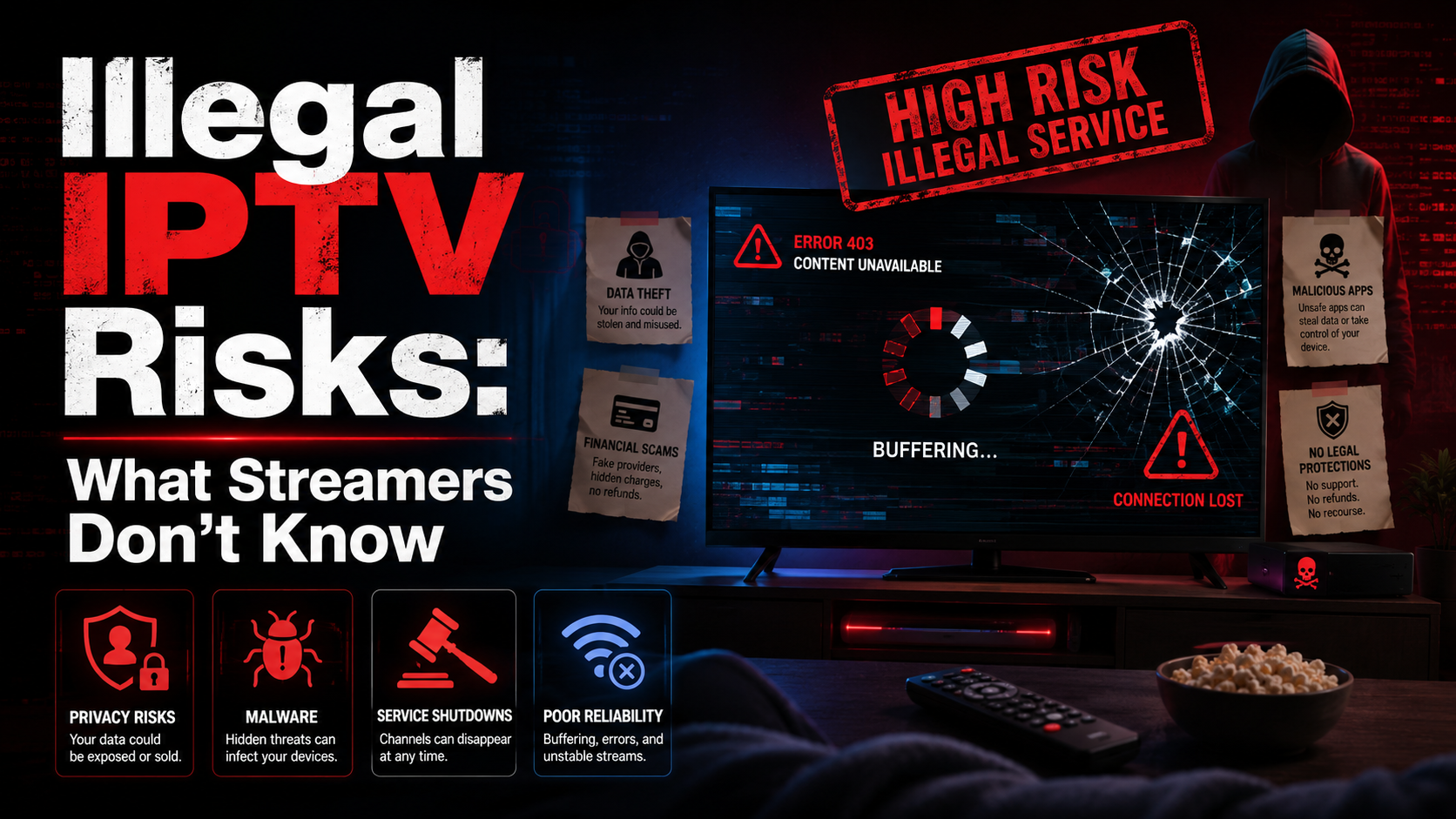
Illegal IPTV risks are far more serious than most streamers ever stop to consider — and I say that after years of testing hundreds of streaming apps and services for this site. The worst-case scenario isn’t a buffering screen during a big match. It’s malware quietly running on your device, your payment details sitting in a criminal database, and legal exposure that sharpens every year as enforcement agencies get smarter. This article lays it all out in plain English so you can make an informed decision.
[TOC]
Most people paying $10 or $15 a month for a pirate IPTV subscription dramatically underestimate the illegal IPTV risks involved — assuming the worst-case scenario is a buffering screen during the Champions League final. I used to think exactly that. After years of testing hundreds of streaming apps and services for this site, I’ve seen the full picture — and the illegal IPTV risks that actually matter have almost nothing to do with getting caught watching a football match. We’re talking malware quietly running on your device, your card details sitting in a criminal database somewhere, and legal exposure that grows sharper every year as enforcement agencies get smarter. This article lays it all out in plain English, so you can make an informed decision rather than a naive one.
Why Illegal IPTV Risks Are More Dangerous Than You Think
Illegal IPTV Risks Go Far Beyond Getting Caught
Most conversations about pirate streaming orbit one question: will I get in trouble? That framing misses the bulk of the actual danger — and it dramatically undersells the illegal IPTV risks you’re actually exposed to. Getting a DMCA notice forwarded by your ISP is an inconvenience. The real illegal IPTV risks sit elsewhere — having your device quietly compromised by a sideloaded APK that harvests your credentials is a genuinely serious problem — one that can cost you real money with zero warning and no court case required. These two illegal IPTV risks aren’t in the same category, and most people are laser-focused on the lesser one.
I’ve personally installed and analyzed dozens of free IPTV apps over the years — not to use them long-term, but to understand what they’re actually doing under the hood. What I keep finding is that the illegal IPTV risks at the device level are the part nobody discusses — and those risks hit you whether or not any authority ever looks your way.
The Infrastructure Behind Pirate Streams
Pirate IPTV doesn’t run on goodwill and open-source enthusiasm. These are commercial operations. Many generate millions of dollars annually, running server infrastructure that requires serious capital — and that infrastructure is often linked to broader criminal networks with existing money-moving mechanisms already in place. When you pay a subscription fee, you’re not just bending copyright law. The illegal IPTV risks extend well beyond copyright infringement — you’re plugging into a criminal financial ecosystem, and that’s one of the most underappreciated illegal IPTV risks of all.
Enforcement has escalated sharply over the past two years. Operations like ACE (Alliance for Creativity and Entertainment) and Operation 404 out of Brazil have dismantled hundreds of pirate services since 2023. The trend has shifted toward identifying and contacting end-users directly — not just going after the operators. That shift makes the illegal IPTV risks for ordinary subscribers far more concrete than they were five years ago.
Financial Crime Connections: Follow the Money
How Pirate IPTV Revenue Gets Laundered
Here’s the part of the illegal IPTV risks conversation that almost never gets explained clearly — and it’s arguably the most consequential aspect of those illegal IPTV risks for everyday subscribers. When you pay around $12/month to a pirate service via crypto or a sketchy payment processor, that money doesn’t just sit in someone’s PayPal account. It moves through layered financial structures specifically designed to obscure its origin.
Europol’s reporting on illicit streaming has documented consistent patterns: subscription revenue flows through shell companies — often registered in jurisdictions with weak financial oversight — then gets converted into what looks like legitimate business income. Some operations use money mule networks, third parties who receive payments, take a cut, and forward the funds up the chain. Those individuals are frequently unknowing participants who answered a “work from home” ad online. The whole pipeline is a textbook money laundering operation, just wrapped in a user-friendly streaming interface.
Who Actually Profits When You Pay $10/Month
It’s rarely the person who sold you the subscription. Reseller panels — which let anyone buy access in bulk and flip it to customers — mean there are often three or four layers between your payment and whoever actually controls the content servers. The people at the top of that chain have significant incentive to protect their revenue by any means necessary. That includes embedding tracking inside their apps and maintaining detailed data on paying customers as potential leverage.
The financial crime connections tied to illegal IPTV risks aren’t sensationalism — they’re documented in court filings from ACE takedowns and in Europol’s annual Internet Organised Crime Threat Assessment (IOCTA) reports. Understanding these illegal IPTV risks is essential before you hand over your card number. Europol’s IOCTA specifically flags illicit IPTV as a significant revenue stream for organized crime groups across Europe. That context matters when you’re deciding where to put your card number.
Device-Level Risks Most Streamers Ignore
Malware Bundled Inside Free IPTV Apps
This is where I want to spend some real time. It’s the angle that gets the least attention and causes the most actual harm. Free IPTV apps distributed outside official stores — sideloaded APKs from Telegram channels, random APK mirror sites, or Discord groups — represent some of the most underreported illegal IPTV risks, frequently bundling secondary payloads right alongside the streaming functionality. These device-level illegal IPTV risks are the ones that cost real people real money.
I’ve decompiled APKs that contained aggressive adware frameworks injecting ads into unrelated apps — a concrete example of illegal IPTV risks that never make the headlines, yet represent genuine financial and privacy danger for the end user. Others requested SMS access for no streaming-related reason whatsoever. One particularly nasty example I came across attempted to access the device’s full contact list. None of these behaviors were disclosed anywhere, because there was no privacy policy. The stream worked fine. The malware worked fine too, quietly running in the background the whole time.
If you want to understand more about how sideloading works on Fire TV devices — and what you’re actually agreeing to when you install apps outside the official store — our piece on Fire TV sideloading methods covers the technical process and the security implications in detail.
How Pirate Apps Request Dangerous Permissions
A legitimate streaming app needs very few device permissions: internet access, storage access to cache content, and maybe camera or microphone for certain smart TV features. That’s genuinely it. So when an IPTV app asks for access to your contacts, call logs, location data, or device — that’s one of the clearest on-device illegal IPTV risks you’ll encounter, and most users just tap Allow without a second thought.e admin privileges, those requests should be immediate red flags. I’ve seen pirate apps demand six to eight permissions with zero relevance to watching video.
Android’s permission model does let users review these requests — but most people just tap “Allow” without reading. On a Firestick specifically, the interface makes permission prompts easy to dismiss quickly (this happens before you even see the channel list, annoyingly), and many sideloaded apps front-load every request right at install.
Your Firestick Is Not a Sandbox
A lot of people assume their streaming device is somehow isolated — that whatever an app does on their Firestick stays on their Firestick. That’s not how it works. Your Fire TV shares your home network. An app with network permissions can, in theory, probe other devices on that network, exfiltrate data over the internet, or serve as a persistent access point for longer-term intrusion. I’m not saying every pirate IPTV app does this. But the documented cases where they do exist, and the possibility alone should factor into your risk calculation.
We’ve also covered how pirate apps contribute to broader Firestick performance issues — slowdowns, overheating, unexpected battery drain — which are often the visible symptoms of background processes running things they absolutely shouldn’t be.
Legal Exposure for End Users in 2026
Are ISPs Actively Reporting Piracy?
In the US, major ISPs participate in content protection frameworks that require them to forward DMCA notices to subscribers. Comcast, AT&T, Spectrum — they’ve all been doing this for years. What’s changed more recently is that rights holders have started going further: requesting subscriber identity information through court orders to pursue civil litigation directly. This is more common in the UK and parts of Europe, but US courts have granted similar discovery orders in several recent cases too.
ISPs don’t typically report proactively to law enforcement for casual piracy. They do log traffic, though. They respond to legal process. And they will throttle connections they identify as streaming pirated content. Your ISP sees more of what you’re doing than most people assume.
What a DMCA Notice Actually Means for You
Getting a DMCA notice from your ISP is a warning, not a criminal charge. Most first-time notices result in nothing beyond the notice itself. Repeated violations can lead to service termination under your ISP’s acceptable use policy, and a documented pattern of infringement can theoretically support a civil lawsuit — though pursuing individual subscribers is expensive and relatively uncommon in the US compared to the UK.
The risk calculation is different in Europe. Germany, France, and Italy have all pursued end-user cases with real financial consequences. Germany in particular has a well-documented history of civil litigation against individual pirates, with settlements running into thousands of euros per incident. The IPTV piracy consequences in those markets are concrete and financial, not hypothetical.
Countries Where End-User Penalties Are Real
UK enforcement has accelerated sharply. The Federation Against Copyright Theft (FACT) and the Police Intellectual Property Crime Unit (PIPCU) have both ramped up subscriber-level investigations since 2024. Several enforcement actions in 2024 and 2025 resulted in fines, and in a small number of commercial-scale cases, actual prosecution. Italy’s Piracy Shield system — launched in early 2024 — actively blocks pirate streams at the network level and has been extended to target repeat subscribers. If you’re in the EU or UK, the cord-cutting legal risks tied to pirate IPTV are meaningfully higher than they were even three years ago.
The Hidden Data Privacy Problem
What Pirate Services Know About You
When you sign up for a pirate IPTV service, you typically hand over an email address, a payment method, and sometimes your name. That data goes into a database controlled by an operation with no legal accountability, no GDPR compliance, and no privacy policy worth the paper it isn’t printed on. These services know your viewing habits — every channel change, every timestamp — because that data is necessary for their servers to function. They keep it indefinitely, with zero regulatory oversight.
The illegal streaming dangers here aren’t limited to copyright. Your personal data is sitting in a system that could be breached, sold to a third party, or used as leverage at any point. There’s no data protection authority to contact. No right to erasure. No recourse of any kind.
Payment Data Exposure and Fake Billing Pages
Some pirate IPTV services run legitimate-looking payment pages that are actually harvesting card data directly — completely separate from any real payment processor. I’ve seen checkout flows that closely mimic Stripe’s interface but route to a different endpoint entirely (yes, they’re that polished about it). Even services that use genuine payment processors carry risk: if the service gets dismantled by authorities, your payment data may be among the assets seized or exposed in the process.
A VPN helps with some passive surveillance risks. It does not solve the trust problem here. If you hand your card number to a criminal operation, the encryption between your device and their server doesn’t protect that data once it’s been received on their end. We cover VPN limitations in more detail in our piece on VPN bans, censorship, and IPTV — worth reading alongside this one if you’re wondering whether a VPN makes pirate services safe to use. The short answer: it doesn’t.
Legitimate Alternatives That Actually Compete on Price
Free Legal Options That Rival Pirate Streams
The honest reason most people use pirate IPTV is price. That objection has gotten significantly weaker over the past couple of years. Free, fully legal options have expanded dramatically. Pluto TV now offers over 250 live channels at zero cost. Tubi carries a massive on-demand library. Plex has added live TV and free ad-supported channels. In the US, Peacock’s free tier and Samsung TV Plus cover a lot of ground without requiring a credit card at all. For local channels, an OTA antenna paired with a DVR service covers the major networks entirely for free.
None of these require a payment method up front. None of them bundle malware. And none of them put you anywhere near a DMCA notice.
Cheap Paid Services Worth Considering in 2026
Philo runs around $28/month for 70+ channels — one of the most underrated legal options available in the US right now. Sling TV’s base tier starts at $40/month but regularly runs promotional pricing at half that, especially for new subscribers. DirecTV Stream, Hulu + Live TV, and YouTube TV all cover premium sports packages, which is usually the main reason someone starts looking at pirate services in the first place.
For a full breakdown of where to start, our guide to legal streaming alternatives covers seven solid options with current pricing — and the cost comparison to pirate services is closer than most people expect once you factor in the risks we’ve laid out here.
Bodhi’s Honest Take: Is It Ever Worth the Risk?
I get it. A pirate service bundling 10,000 channels, every major sports league, and 50,000 VOD titles for $15/month looks like an absurd value compared to paying $75/month for a legal live TV package. I’ve been in that position. The appeal is real.
But the risk-to-reward ratio has genuinely shifted heading into 2026. Enforcement is sharper and better resourced. Malware distribution through IPTV apps is more documented and more common than it was three years ago. Payment fraud risks are real, not theoretical. And the legal alternatives have improved enough that the value gap is narrower than most people expect.
My honest position: the people most at risk from pirate IPTV aren’t necessarily the ones law enforcement is most focused on. They’re the ones most exposed to device compromise and data theft. Those risks don’t require a court case to hurt you. A compromised Firestick or a stolen card number costs you money and time, with no warning and no recourse.
Start with the legal options. If you’re going to cord-cut, do it in a way that doesn’t hand your device and your payment data to an operation with zero accountability. That’s not moralizing — it’s just a better deal.
⚖️ Legal Disclaimer: IPTV Wire does not own or operate any streaming service, application, or website mentioned in this article. We do not verify whether third-party services carry proper licensing. Users are responsible for ensuring they comply with copyright laws in their jurisdiction.
Frequently Asked Questions About Illegal IPTV Risks
Can you get in legal trouble for watching illegal IPTV as a subscriber?
Yes, though the risk level varies significantly by country. In the US, civil liability is the more realistic concern for individual subscribers — criminal prosecution for passive viewing is rare. In the UK, Germany, Italy, and several other EU countries, end-user enforcement has produced real fines and, in commercial-scale cases, criminal charges. Enforcement against subscribers is increasing across all major markets as of 2025–2026, and the trend shows no signs of slowing.
Does a VPN protect you from illegal IPTV risks?
Partially — but not in the ways most people assume. A VPN can mask your traffic from your ISP, which reduces the likelihood of receiving a DMCA notice. It does not protect you from malware bundled in sideloaded IPTV apps. It does not secure your payment data once it’s been submitted to a pirate service. And it does nothing to prevent data collection by the service itself. A VPN is one layer of protection, not a complete solution to the illegal IPTV risks involved.
What happens if your ISP detects you using a pirate IPTV service?
In most cases, the first action is a forwarded DMCA notice or a warning letter. Repeated violations can result in connection throttling or, in some cases, service termination under your ISP’s acceptable use policy. US ISPs don’t typically report subscribers to law enforcement for passive viewing — but they do respond to court-ordered requests from rights holders for subscriber identity information, and those requests have become more common since 2024.
Are free IPTV apps on Firestick safe to use?
It depends entirely on the source. Free IPTV apps distributed through official channels like the Amazon Appstore go through a review process. Sideloaded APKs from unofficial sources carry meaningful risk — I’ve personally analyzed apps in this category that bundled adware, demanded invasive permissions with no streaming-related justification, and in one case attempted to access device contact data entirely unprompted. Treat any sideloaded free IPTV app with real skepticism until you can verify what it’s actually doing on your device.
How do I know if an IPTV service is legal or not?
Legal IPTV services have verifiable company registrations, clear licensing statements, named ownership, and operate through official app stores or well-documented platforms. They charge prices that reflect the actual cost of licensing content — typically $30/month or more for live TV packages. Services charging $10–15/month for thousands of channels including premium sports, HBO, and pay-per-view events are almost certainly operating without licenses. No clear company name, no registered address, payment through informal channels — if those things are true, treat it as unlicensed. Availability and enforcement vary by region, but that basic checklist applies everywhere.

Comments are closed.